Strategic estate planning is a cornerstone of financial security for expatriates residing in Vietnam. A comprehensive understanding of Vietnam inheritance law is imperative to ensure that assets are distributed strictly according to the testator’s intent. While the Vietnamese legal framework affords protection to property rights, the intricacies surrounding drafting a will in Vietnam, coupled with statutory restrictions on foreign real estate ownership and inheritance tax, necessitate professional legal oversight.
This guide delineates the legal necessity of testamentary documents, the statutory formalities for validity, and the critical distinctions regarding real property inheritance under the Civil Code, Law on Housing 2023, and Law on Land 2024.
1. The Legal Necessity of a Will in Vietnam
Drafting a will (testament) is the primary legal instrument to mitigate potential succession disputes and safeguard the testator’s autonomy over asset distribution.
Avoiding Statutory Intestacy
In the absence of a valid will, the estate is distributed “according to law” (intestacy) pursuant to the Civil Code. This mandates a distribution hierarchy where the estate is divided equally among the first rank of heirs (spouse, biological/adoptive parents, and biological/adoptive children), irrespective of the deceased’s relationship quality or personal wishes.
Minimizing Cross-Border Conflict
A clearly articulated will serves to preempt litigation among beneficiaries, a common risk when assets span multiple jurisdictions. It establishes a definitive legal basis for asset division, reducing ambiguity and emotional distress for surviving family members.
2. Formalities: Ensuring Legal Validity
To ensure a will is legally enforceable within the Vietnamese jurisdiction, strict adherence to statutory forms is required.
Notarization: The Gold Standard
To maximize legal security, it is strongly advised to execute a written will that is notarized by a Notary Public or certified by a competent authority. A notarized will serves as robust evidentiary proof of the testator’s:
- Mental Capacity: Confirming the testator was of sound mind.
- Voluntariness: Confirming the absence of coercion or deception at the time of execution.
Witness Requirements
If a will is not notarized, the Civil Code imposes stringent requirements on witnesses to establish validity. Witnesses must be disinterested parties who fully understand the content and confirm the testator’s signature. Failure to comply with these formalities renders the will void ab initio.
3. Real Estate Inheritance: Title Ownership vs. Value Entitlement
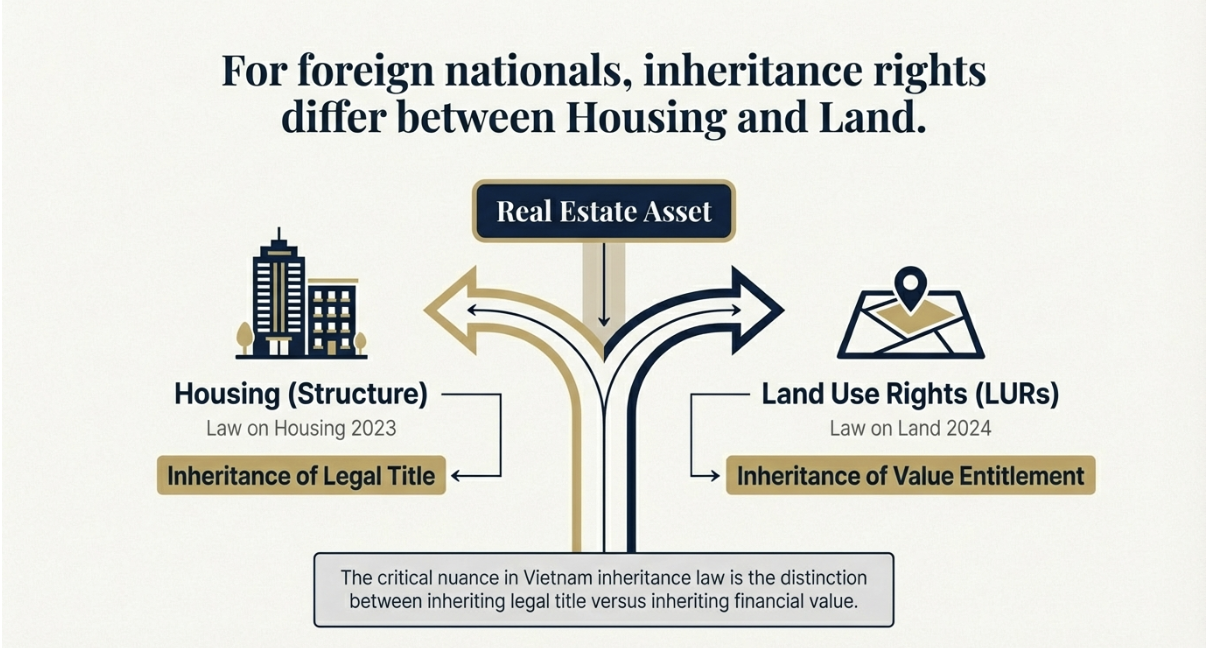
For foreign nationals, the most critical nuance in Vietnam inheritance law lies in the distinction between inheriting legal title (ownership) versus inheriting the financial value of the property.
Inheritance of Housing (Residential Structures)
Pursuant to the Law on Housing 2023, foreign individuals legally permitted to enter Vietnam are eligible to own housing (specifically apartments and separate houses within commercial housing investment projects) through inheritance.
- Ownership Rights: Eligible foreign heirs may be issued a Certificate of Ownership for the property.
- Statutory Restrictions: Ownership is subject to strict quotas (e.g., maximum 30% of apartments in a single condominium building) and term limits (typically 50 years, renewable), unless the foreigner marries a Vietnamese citizen.
Inheritance of Land Use Rights (LURs)
The Law on Land 2024 maintains a restrictive stance regarding land. Foreign individuals (excluding “Vietnamese residing abroad” retaining Vietnamese nationality) are generally not permitted to hold Land Use Rights directly.
- Value Entitlement (Article 28): If a foreign beneficiary is ineligible to be issued a Certificate of Land Use Rights, they are legally entitled to receive the value of the inheritance rather than the title itself.
- Procedural Implication: In practice, the inherited land use rights must be alienated (sold or transferred) to a qualified entity (e.g., a Vietnamese citizen), with the foreign heir receiving the liquidation proceeds in cash.
Exception: Vietnamese Residing Abroad
Vietnamese citizens residing abroad who retain Vietnamese nationality enjoy broader property rights, often holding eligibility to inherit both land use rights and housing comparable to domestic citizens.
4. Inheritance Tax in Vietnam
Understanding the fiscal implications of succession is vital for effective estate planning. Note: Tax regulations are subject to the Law on Personal Income Tax.
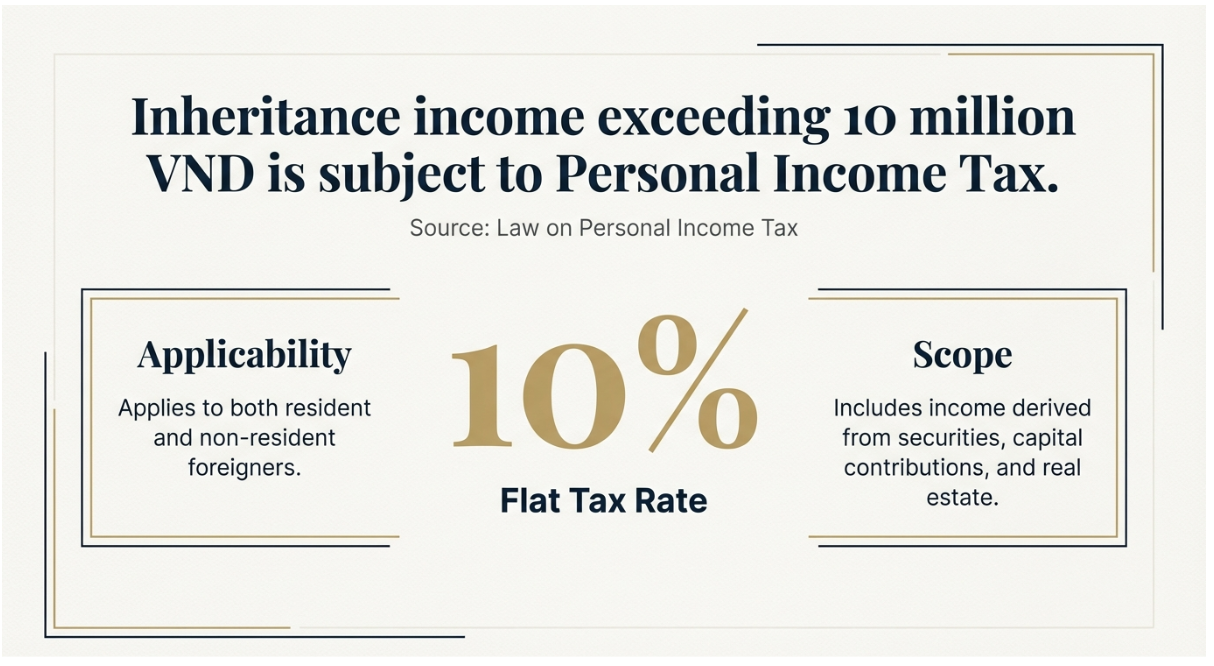
- Personal Income Tax (PIT): Income derived from inheritance (including securities, capital contributions, and real estate) exceeding 10 million VND is generally subject to a 10% Personal Income Tax for both resident and non-resident foreigners.
- Statutory Exemptions: Crucially, inheritance of real estate between immediate family members (spouses, parents/children, grandparents/grandchildren, siblings) is typically exempt from Personal Income Tax.
📞 Contact DHH Law Firm Today
Drafting a will that complies with Vietnamese law while aligning with your international estate plan requires expert legal guidance. Secure your legacy and protect your family’s future.
🏢 Main Office: 2nd Floor, 829 Huynh Tan Phat Street, Phu Thuan Ward, Ho Chi Minh City, Vietnam
📞 Hotline:
- +84 89 9352 777 (Vietnamese)
- +84 89 9351 777 (English)
🌐 Website: www.dhhlawfirm.vn
📧 Email: contact@dhhlawfirm.vn
✨ DHH Law Firm – Your trusted legal partner for family and foreign-related civil procedures in Vietnam.