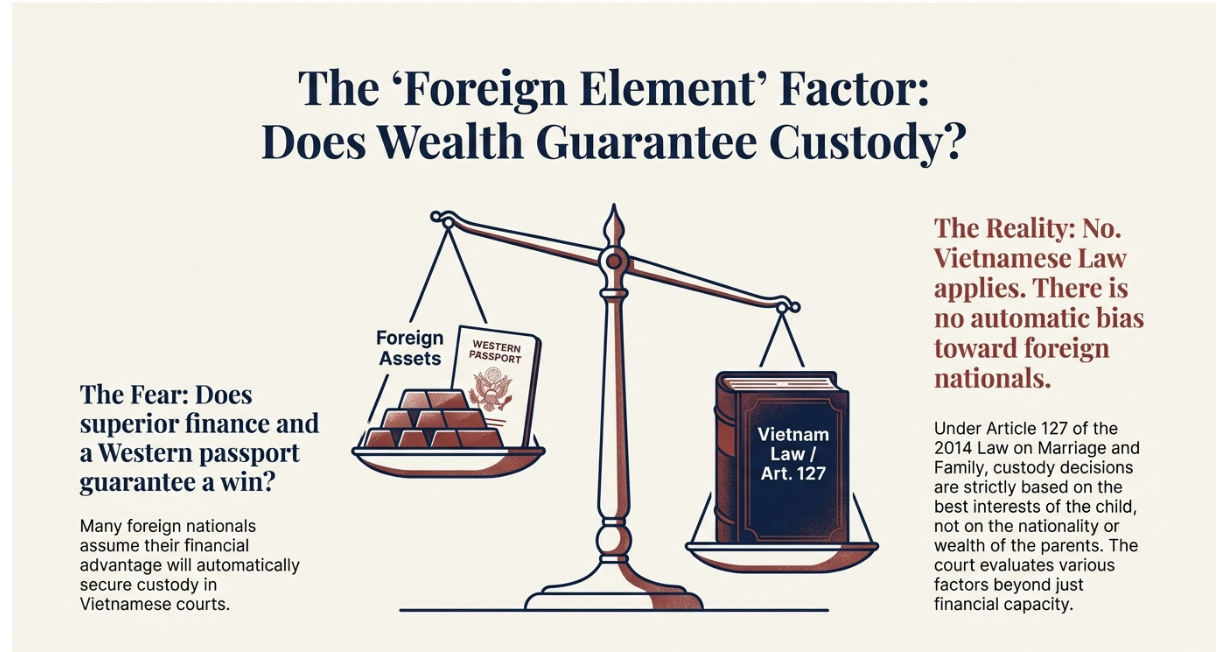
When entering a legal battle to gain child custody against a foreign national, many Vietnamese parents experience anxiety and fear, worrying that the opposing party holds an advantage due to superior finances, foreign citizenship, or living conditions in developed countries. However, does Vietnamese law automatically award custody to the higher-income earner?
This article provides a detailed analysis of current legal provisions regarding child custody disputes with a foreign element, helping you understand the Court’s adjudicative principles and how to maximally protect your rights and those of your child.
1. Principles for Resolving Child Custody Disputes with a Foreign Element
Pursuant to Article 127 of the 2014 Law on Marriage and Family, the resolution of divorce and child custody between a Vietnamese citizen and a foreign national in Vietnam shall be subject to Vietnamese law.
The supreme principle consistently applied by Vietnamese Courts is: Considering the best interests of the child in all aspects. There is no discrimination or bias between a Vietnamese citizen and a foreign national.
Specifically, the Court will follow these age-based milestones:
- Children under 36 months of age: In principle, direct custody shall be awarded to the mother, unless she is unqualified to directly care for, rear, and educate the child (or if the parents have a different agreement).
- Children aged 07 and older: The Court is legally obligated to consider the child’s wishes regarding whom they want to live with. (However, the child’s opinion is only a reference point; the Court makes the final decision based on the actual conditions of each parent).
2. Winning Custody Against a Foreign Spouse: What Factors Does the Court Consider?
To answer the question “Who has the advantage?”, the Court will comprehensively weigh the conditions of both parties. The fact that a foreign national has a higher income does not guarantee they will win the case.
Material Conditions (Finances and Accommodation)
The Court will review the monthly income, assets, and stable accommodation of each party.
- Legal Reality: You do not need to be wealthier than your foreign spouse. You only need to prove that your income is lawful, stable, and sufficient to meet the child’s essential needs (food, housing, education, healthcare) in Vietnam.
Mental and Emotional Conditions (Living Environment and Caregiving Time)
This is often the factor where the Vietnamese parent holds a significant advantage, especially if the child is currently living and studying in Vietnam:
- Time: Who has more time to be with, care for, and take the child to school? If the foreign national frequently travels for business and has a hectic schedule, the Court will be hesitant to award them custody.
- Cultural & Social Environment: The Court highly values stability. If the child is accustomed to their living environment, friends, school, and local customs in Vietnam, abruptly awarding custody to the foreign national and removing the child from the territory could cause severe psychological disruption.
- Character and Morality: The care, affection, and bond between the parent and the child.
The Child’s Nationality
If the child holds Vietnamese nationality and is residing in Vietnam, granting custody to the Vietnamese parent is usually prioritized to ensure the child develops within their native cultural environment—unless the foreign environment is proven to be vastly superior and appropriate for the child’s specific circumstances.
3. The Child’s Exit from the Country and Post-Divorce Child Support Obligations
The two biggest concerns for Vietnamese parents after a divorce judgment takes effect are financial maintenance and the fear that the opposing party will secretly take the child abroad.
Child Support (Maintenance)
- The non-custodial parent has the obligation to provide child support. The support amount is agreed upon by both parties; if no agreement can be reached, the Court will decide based on the actual income of the obligated party and the essential needs of the child.
- Note: Enforcing a child support judgment against someone residing abroad is practically very complex. You should request the Court to order a lump-sum payment (instead of monthly payments) if there is evidence of their assets in Vietnam, or request an offset against common property during the asset division phase.
Exiting the Country (Relocating Abroad)
Many fear that the foreign national, upon gaining visitation rights or custody, will arbitrarily take the child back to their home country.
- Under the Law: Issuing a Vietnamese Passport or applying for an exit visa for a child under 14 usually requires the written consent of both parents, or a clear Court Decision/Judgment permitting the change of the child’s residence abroad.
- If the other party attempts to secretly take the child away, they are violating laws on the child’s right to residence and the other parent’s right to visitation and care. You have the right to request competent authorities (Border Police, the Court) for emergency intervention.
📞 Contact DHH Law Firm Today
If you have any questions or require legal assistance regarding Work Permits, please contact DHH Law Firm:
🏢 Main Office: 2nd Floor, 829 Huynh Tan Phat Street, Phu Thuan Ward, Ho Chi Minh City, Vietnam
📞 Hotline:
- +84 89 9352 777 (Vietnamese)
- +84 89 9351 777 (English)
🌐 Website: www.dhhlawfirm.vn
📧 Email: contact@dhhlawfirm.vn
✨ DHH Law Firm – Your trusted legal partner for family and foreign-related civil procedures in Vietnam.