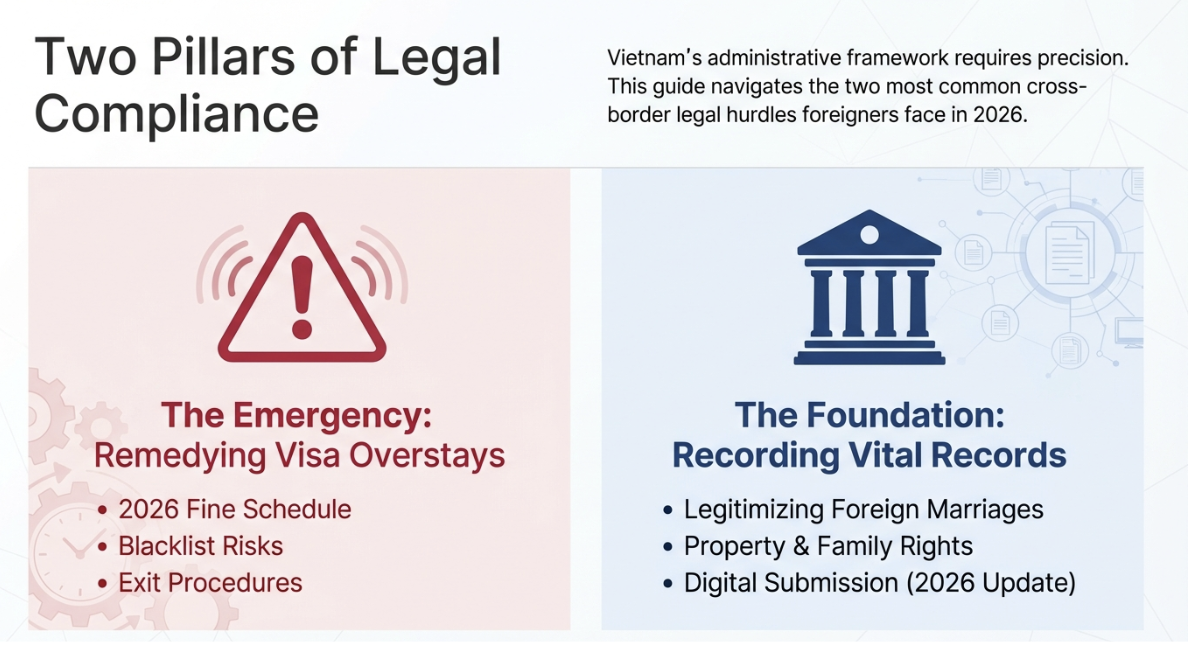
Finding out that a relative or foreign business partner has overstayed their visa in Vietnam is undoubtedly a stressful experience. Violating the permitted duration of stay not only leads to heavy financial penalties but also carries the risk of deportation or a permanent ban on entry.
However, instead of panicking or attempting to conceal the issue, it is crucial to remain calm and handle the situation according to proper legal procedures. The article below provides the latest 2026 updates on visa overstay fines and guides you on the safest ways to resolve this situation.
1. Updated Schedule of Fines for Overstaying Visas in Vietnam
According to the Government’s Decree 144/2021/ND-CP, violations regarding exit, entry, transit, residence, and travel are subject to administrative fines. The penalty amount directly depends on the number of days the foreigner has overstayed.
Below is a detailed summary of the fines:
| Number of Days Overstayed | Fine Amount (VND) |
| Under 16 days | 500,000 – 2,000,000 |
| From 16 days to under 30 days | 3,000,000 – 5,000,000 |
| From 30 days to under 60 days | 5,000,000 – 10,000,000 |
| From 60 days to under 90 days | 10,000,000 – 15,000,000 |
| 90 days or more | 15,000,000 – 20,000,000 |
Note: The above fines apply to individuals. If a foreigner entered Vietnam under the sponsorship of a company or organization, the sponsoring entity may also be held jointly liable and face administrative fines.
2. The Risk of Deportation and Being Placed on the Immigration Blacklist
Paying a fine is not the only consequence of overstaying a visa in Vietnam. Depending on the severity of the violation (number of days overstayed, level of cooperation, reasons for the overstay), the immigration authority may impose severe supplementary penalties:
- Forced Exit / Deportation: The foreigner may be ordered to leave Vietnam immediately or be escorted and deported back to their home country.
- Placement on the Blacklist (Entry Ban): This is the most significant risk. The immigration system may record a violation and issue a decision banning the foreigner from re-entering Vietnam for a period of 1 year, 3 years, 5 years, or permanently. Securing a Vietnamese visa in the future will become extremely difficult.
3. Procedure for Applying for an Exit Visa or a Safe Extension
Many people mistakenly believe they can simply go straight to the airport, pay the fine there, and fly home. In reality, if you have overstayed for an extended period, you will likely be stopped by airport security, miss your flight, and be directed back to the Immigration Department to provide a formal explanation.
Here are the correct steps to handle the situation:
Scenario 1: Applying for an Exit Visa to Leave Vietnam
If the foreigner simply wants to pay the fine and return home, they must apply for an exit visa (which is usually granted with a short validity of 7 to 15 days to allow time to arrange a flight):
- Prepare the dossier: Original passport, Application Form for Visa Issuance/Temporary Residence Extension (Form NA5), and an Explanatory Report stating the reasons for the overstay. The report must clearly detail any force majeure events (severe illness, lost documents, canceled flights) or sincerely admit to personal negligence.
- Submit the dossier: Present yourself at the Vietnam Immigration Department (in Hanoi or Ho Chi Minh City) or the Immigration Office of the Provincial Police.
- Pay the fine & Receive the Exit Visa: Receive the penalty decision, pay the fine at the designated state treasury, and retrieve the passport bearing an exit permission stamp.
Scenario 2: Paying the Fine and Applying for a Visa Extension to Stay
Applying for a visa extension after incurring a visa overstay fine is highly difficult, and the competent authorities review these applications with extreme strictness.
- You only have a chance of being granted an extension if you have a highly legitimate reason (e.g., undergoing treatment for a critical illness, supported by a certification from a central-level hospital) or a strong basis for sponsorship (e.g., being the spouse of a Vietnamese citizen or a major investor).
- The submission process is similar to the above, but on Form NA5, you must select the option for a temporary residence extension and attach all necessary legal documents proving your valid reason to remain in Vietnam.
📞 Contact DHH Law Firm Today
If you have any questions or require legal assistance regarding Work Permits, please contact DHH Law Firm:
🏢 Main Office: 2nd Floor, 829 Huynh Tan Phat Street, Phu Thuan Ward, Ho Chi Minh City, Vietnam
📞 Hotline:
- +84 89 9352 777 (Vietnamese)
- +84 89 9351 777 (English)
🌐 Website: www.dhhlawfirm.vn
📧 Email: contact@dhhlawfirm.vn
✨ DHH Law Firm – Your trusted legal partner for family and foreign-related civil procedures in Vietnam.