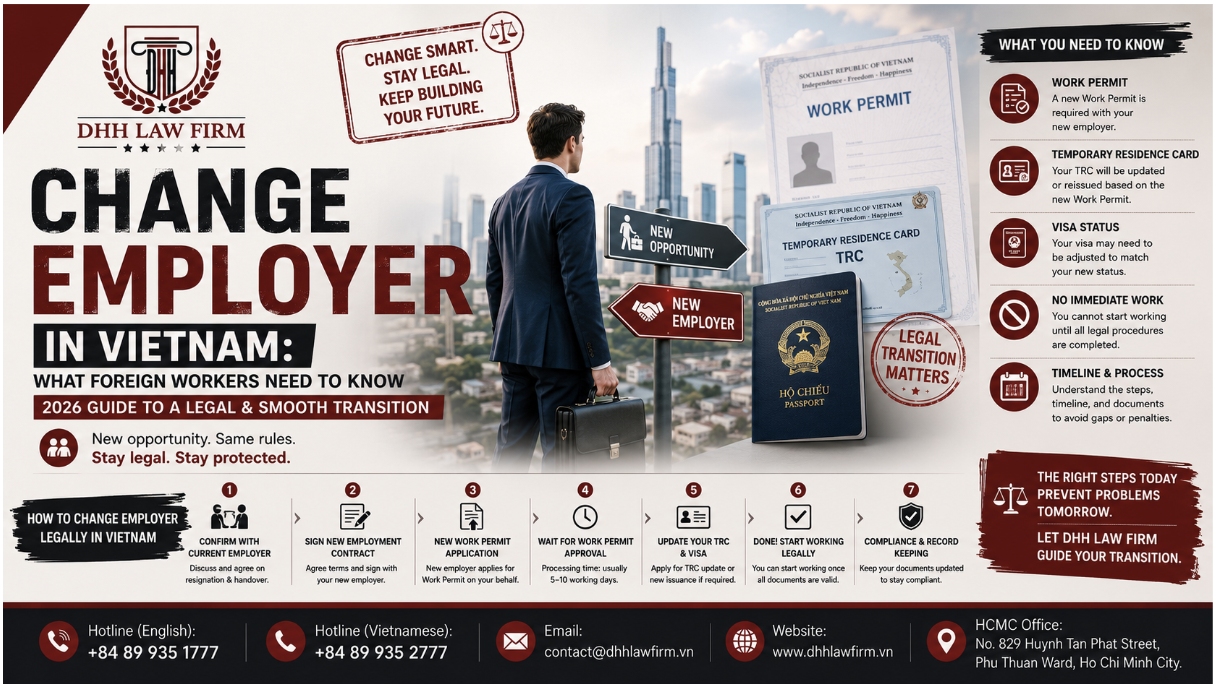
Changing Employers in Vietnam? Don’t Start the New Job Yet
You have worked for the same company for two years. Then you receive a better offer. Higher salary. Better position. Better career prospects.mYou resign from your current employer and sign a new employment contract.
Your new HR team says: “You already have a valid Work Permit. You can start next Monday.” That sounds reasonable.
But there is an important question:
Does your existing Work Permit actually allow you to work for your new employer?
For foreign workers in Vietnam, changing employers is not simply an HR decision. It can affect your Work Permit, employment authorization, visa, Temporary Residence Card (TRC), sponsor and immigration status.
Under the current framework, Decree 219/2025/ND-CP, effective from August 7, 2025, governs foreign workers working in Vietnam and the relevant Work Permit procedures.
So before you walk into your new office for the first day, make sure your immigration and employment status is ready for the change.
Quick Answer: Can a Foreigner Change Employers in Vietnam?
Yes. Foreign workers can change employers, but you should not assume that an existing Work Permit automatically transfers to the new company.
Your new employment arrangement needs to be assessed under the current foreign-worker regulations.
Foreign professional signing a new employment contract after changing employers in Vietnam
The important distinction is:
Changing jobs is not the same as transferring your existing Work Permit.
In many cases, the new employer will need to carry out the appropriate Work Permit procedure based on the new employment relationship. Your visa or TRC may also need to be reviewed because your immigration status may be connected to your employer or sponsor.
1. Your Work Permit Belongs to the Employment Arrangement — Not Just to You
This is the first misconception to clear up. A foreign worker may say: “I have a Work Permit.”
But the more important question is: “What employer, position and work arrangement does that Work Permit cover?”
Your new employer is not automatically covered simply because you personally already hold a Work Permit. This matters particularly when you move from: Company A → Company B or when there is a significant change in your position, job duties or employment arrangement.
Therefore, before starting your new position, your new employer should review whether a new Work Permit application or another applicable procedure is required.
2. Can You Use Your Old Work Permit for the New Employer?
This is probably the most searched practical question. The safest answer is: Do not assume that you can.
An existing Work Permit does not automatically become a general authorization to work for any employer.
Vietnam’s current foreign-worker framework requires the employment relationship and applicable Work Permit conditions to be considered for the new employer. Decree 219/2025/ND-CP sets out the current rules governing foreign workers and Work Permit procedures.
So if Company A sponsored your employment and you move to Company B, Company B should assess the appropriate legal procedure before you begin working. This is particularly important because starting first and fixing the paperwork later can create unnecessary compliance risks.
3. What Happens to Your Old Work Permit?
When you leave your previous employer, the old employment arrangement comes to an end. That does not mean you should simply continue using the old Work Permit as though nothing has changed.
The practical question becomes: What legal authorization do I need for my new employer?
Depending on the circumstances, the new employer may need to proceed with a new Work Permit application rather than a simple “transfer.” This is why DHH LAW FIRM recommends reviewing the new job before the employee’s first working day.
A five-minute assumption can otherwise turn into a much longer compliance problem.
4. What If My Old Work Permit Is Still Valid?
This is where many foreign workers become confused. Imagine:
Work Permit expires: December 2027
You leave Company A: September 2026
New job at Company B: October 2026
You may think: “My Work Permit is valid until 2027, so I’m covered.”
The expiry date alone does not answer the question. The relevant issue is whether that authorization applies to your new employment arrangement. A valid document is not necessarily a universal employment authorization. This is one of the most important concepts to understand when planning a change employer Vietnam case.
5. What Happens to Your Visa or TRC?
Changing employers can also create an immigration issue. Suppose your current residence status was arranged through your former employer. You leave that employer. Then you start working for another company. Your new employer may be different. Your sponsor may be different.
Your immigration documents may therefore need to be reviewed. This is particularly important if you hold a Temporary Residence Card (TRC).
Do not simply assume:
“My TRC is valid until 2028, so I don’t need to do anything.”
The validity date is only one part of the analysis. The legal basis and sponsoring relationship should also be considered.
- The New Employer Should Check Your Situation Before You Start
A common mistake is to leave the immigration issue entirely to the employee. But the new employer also has responsibilities. Before onboarding a foreign worker, HR should know:
What position will the foreign worker perform?
Does the position require a Work Permit?
Does the worker qualify for an exemption?
What Work Permit procedure applies?
What immigration status does the worker currently hold?
Does the sponsor need to be changed?
This is why an employer should not simply ask: “Do you already have a Work Permit?”
A better question is: “Does your current immigration and employment authorization cover the job we are hiring you to do?”
That distinction can save both the employer and employee from unnecessary problems.
7. What Does the Change-Employer Process Look Like?
There is no single procedure that applies identically to every foreign worker.
However, a practical transition can look like this:
8. What If You Change Employers but Keep the Same Job Position?
This is another common misconception. You may move from: Marketing Manager at Company A to Marketing Manager at Company B
and think: “The position is exactly the same, so my Work Permit should remain valid.”
The fact that the job title is unchanged does not automatically mean the employment authorization transfers to the new employer. The employer itself is an important part of the employment relationship.
Therefore, the new company should still review the appropriate Work Permit procedure before the employee starts working.
9. What If You Change Both Employer and Position?
This requires even more careful review.
For example: Company A: Financial Analyst – Company B: Finance Manager
Now there are two changes: Employer andPosition
The new employment arrangement should be assessed independently. The new employer should not simply rely on the foreign worker’s previous Work Permit.
10. What If I Quit My Old Job Before Finding a New One?
This is a different situation. If your employment ends before you have a new employer, you should review your immigration status immediately.
You may still have a visa or residence document with remaining validity, but you should not automatically assume that this gives you unlimited time to remain in Vietnam while searching for work. The legal basis for your continued stay matters. This is particularly important if your previous visa or TRC was connected to your former employer.
11. What If I Already Started Working for the New Employer?
If you have already started your new job before the appropriate Work Permit or employment authorization has been addressed, don’t simply continue assuming: “HR will fix it later.”
The correct response is to review the situation as soon as possible. The appropriate solution depends on your circumstances, including:
- your previous Work Permit;
- your new employer;
- your current position;
- your visa or TRC;
- when you started working; and
- whether you qualify for any Work Permit exemption.
DHH LAW FIRM can assess the situation and identify the appropriate next step rather than applying a generic solution to every case.
12. Changing Employer vs. Renewing Your Work Permit
These two procedures are often confused.
| Situation | Main Issue |
| Same employer, approaching Work Permit expiry | Work Permit renewal may be appropriate |
| New employer | New employment authorization should be assessed |
| New employer + new position | New employment arrangement requires careful review |
| Same employer + new position | Work Permit requirements should be reassessed |
| Employment ended, no new employer | Review visa/TRC and lawful basis to remain |
This distinction is especially important under the current framework. Renewal is not simply a mechanism for moving an existing Work Permit from Company A to Company B.
13. The Most Common Mistakes When Changing Employers
Mistake #1 — Starting the new job immediately
A signed employment contract does not automatically mean the foreign worker is ready to begin working.
Mistake #2 — Assuming a valid Work Permit transfers
The fact that your old Work Permit has not expired does not automatically solve the new employer’s requirements.
Mistake #3 — Ignoring the TRC
A change of employer can affect the immigration arrangements associated with your previous sponsor.
Mistake #4 — Letting HR handle only the Work Permit
The Work Permit is only one part of the foreign worker’s legal status.
Mistake #5 — Waiting until the old visa expires
Immigration problems are easier to address when identified before an expiry date or status problem occurs.
Mistake #6 — Relying on another foreigner’s experience
Your friend’s employer, nationality, Work Permit, visa and circumstances may be completely different.
14. A Practical Timeline for Foreign Workers
If you know you are going to change employers, don’t wait until your final working day.
Before resigning – Review your current Work Permit, visa and TRC.
After accepting the new job – Give the new employer enough time to assess the foreign-worker requirements.
Before your first working day – Confirm that the applicable Work Permit and immigration procedures have been properly addressed.
After the transition – Check whether your visa, TRC or sponsorship arrangement needs to be updated.
If anything is unclear – Get professional advice before starting work.
This is much safer than trying to correct the situation after several weeks of employment.
How DHH LAW FIRM Can Help With a Change of Employer
Changing employers as a foreign worker involves more than replacing one employment contract with another. At DHH LAW FIRM, we review the transition from the perspective of both employment authorization and immigration status.
Our team can assess:
- Your existing Work Permit
- The new employer
- The new position
- Your current visa
- Your TRC
- Your sponsor
- Supporting documents
Based on that review, DHH LAW FIRM can help determine the appropriate Work Permit procedure and identify whether your immigration status also needs to be updated. If you have already started working for the new employer, we can also review the existing situation and advise on the appropriate way to address the issue.
For employers, DHH LAW FIRM can assist HR teams in planning the onboarding of foreign employees so that the employment start date is aligned with the applicable legal requirements.
Before You Start Your New Job
If you are a foreign worker changing employers in Vietnam, ask yourself three questions:
Is my existing Work Permit applicable to my new employer?
Does my current visa or TRC still match my immigration circumstances?
Has the new employer completed the appropriate foreign-worker procedures?
If you cannot confidently answer all three, it is better to resolve the issue before your first day at the new company. A new job should be an opportunity for career growth—not the beginning of a Work Permit or immigration problem.
Conclusion
A foreign worker can change employers in Vietnam, but the transition should not be treated as a simple transfer of an existing Work Permit. The new employer, position, Work Permit requirements and immigration status should be reviewed together.
Your old Work Permit may still have months remaining on it, but that does not automatically mean you can use it for your new company. Likewise, your visa or TRC may still show a future expiry date, but a change in employment or sponsorship can require your immigration status to be reassessed.
The safest approach is straightforward: Review first. Complete the appropriate procedures. Then start the new job.
If you are planning to change employer in Vietnam, DHH LAW FIRM can review your current Work Permit and immigration status, assess the new employment arrangement and help you identify the appropriate legal pathway before the transition creates unnecessary complications.
Frequently Asked Questions
-
Can a foreigner change employers in Vietnam?
→ Yes. Foreign workers can change employers, but the new employment arrangement should be assessed under the current foreign-worker regulations. An existing Work Permit should not automatically be assumed to transfer to the new employer.
-
Can I use my old Work Permit for my new company?
→ You should not assume that you can. The new employer needs to determine the appropriate Work Permit procedure for the new employment relationship.
-
What happens to my Work Permit when I change employers?
→ The existing Work Permit does not simply become a general authorization for the new company. The new employment arrangement should be reviewed and the appropriate procedure completed before work begins.
-
Do I need a new Work Permit when changing employers?
→ This depends on your specific circumstances and the applicable legal procedure. The new employer should assess the Work Permit requirements rather than assuming that the old permit can be transferred.
-
Does changing employers affect my TRC?
→ It may. If your TRC or other immigration status is connected to your former employer or sponsor, the change should be reviewed to determine whether an update or new immigration procedure is required.
-
Can I start my new job while the Work Permit procedure is pending?
→ Do not assume that you can. Whether you may legally begin working depends on your specific status and applicable authorization. It is safer to confirm the position before starting work.
-
What if I have already started working for my new employer?
→ You should have your situation reviewed promptly rather than waiting for the paperwork to be completed. DHH LAW FIRM can assess the existing Work Permit, new employment arrangement and immigration status and advise on the appropriate next step.
Contact DHH Law Firm for Support
Hotline (English): +84 89 935 1777
- Hotline (Vietnamese): +84 89 935 2777
- Email: contact@dhhlawfirm.vn
- Website: www.dhhlawfirm.vn
- HCMC Office: No. 829 Huynh Tan Phat Street, Phu Thuan Ward, Ho Chi Minh City.