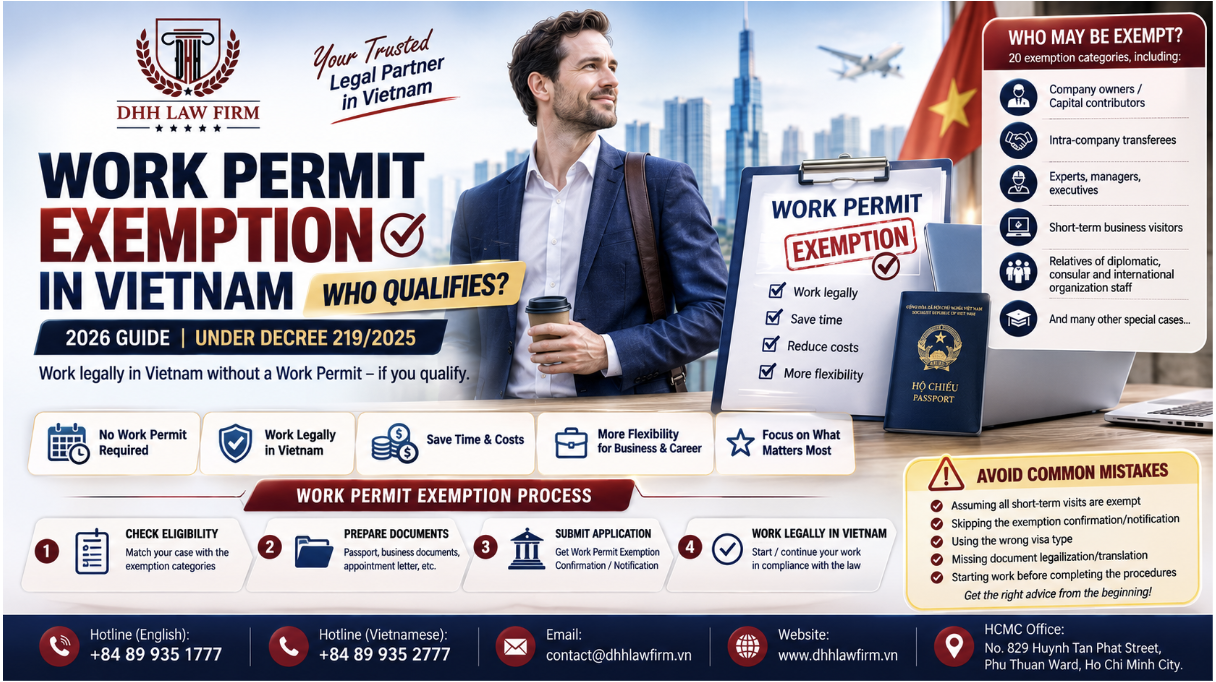
Do You Really Need a Work Permit to Work in Vietnam?
For many foreign professionals, the first question when accepting a job in Vietnam is: “How do I get a Work Permit?” But there is another question that should come before that: “Do I actually need one?”
Vietnamese regulations recognize a number of situations where foreign nationals working in Vietnam are not subject to a Work Permit.
Under Decree 219/2025/ND-CP, effective from August 7, 2025, there are 20 categories of foreign workers who are not subject to a Work Permit. However, “exempt from a Work Permit” does not always mean “no paperwork.”
Depending on the category, the foreign worker may need a Confirmation of Exemption from Work Permit, while certain categories only require notification to the competent authority. That distinction is where many employers and foreign workers make mistakes.
At DHH LAW FIRM, we recommend determining the exemption category first, then identifying what documentation or notification is required before the foreign national starts working.
Quick Answer: Who Can Be Exempt from a Work Permit?
Under Article 7 of Decree 219/2025/ND-CP, exemption categories include, among others:
- Foreigners married to Vietnamese citizens and living in Vietnam
- Foreign investors meeting the applicable capital-contribution threshold
- Certain members of Boards of Directors
- Foreign lawyers licensed to practice in Vietnam
- Certain intra-company transferees
- Foreign students and trainees in qualifying situations
- Certain family members of foreign diplomatic representatives
- Persons responsible for establishing a commercial presence
- Certain volunteers
- Foreign workers entering Vietnam for qualifying short-term work
- Certain managers, executives, experts and technical workers working under specific conditions
- Certain foreign nationals working in education
- Foreign workers in specified priority fields such as finance, science, technology, innovation and national digital transformation, where the required authority confirms the case.
The important point is that eligibility depends on the exact legal conditions of the category. Simply calling yourself an “investor,” “expert,” “manager” or “teacher” does not automatically create an exemption.
The 20 Work Permit Exemption Categories
Instead of reproducing the legislation in dense legal language, here is a practical overview.
| # | Who may qualify? |
| 1 | Persons falling under specified exemption cases in Article 154 of the Labour Code |
| 2 | Owner/member of an LLC with capital contribution of VND 3 billion or more |
| 3 | Chairman/member of a JSC Board of Directors with capital contribution of VND 3 billion or more |
| 4 | Certain persons entering Vietnam for qualifying ODA-funded programmes/projects |
| 5 | Foreign journalists with confirmation from the Ministry of Foreign Affairs |
| 6 | Certain persons sent by foreign competent authorities to teach or manage qualifying educational institutions |
| 7 | Foreign students/trainees in qualifying internship or training arrangements |
| 8 | Certain family members of foreign diplomatic representatives |
| 9 | Holders of official passports working for Vietnamese state or political/social organizations |
| 10 | Persons responsible for establishing a commercial presence |
| 11 | Certain unpaid volunteers under international treaties |
| 12 | Persons entering Vietnam to implement qualifying international agreements |
| 13 | Certain managers, executives, experts and technical workers, including qualifying short-term work and intra-company transfers |
| 14 | Persons entering Vietnam for qualifying educational work confirmed by the Ministry of Education and Training |
| 15 | Foreign workers in specified priority fields confirmed by competent authorities |
| 16–20 | Other cases arising under the Labour Code and specific statutory conditions incorporated into Article 7 |
The exact legal classification matters because different exemption categories have different documentary requirements and procedural treatment.
The Exemption People Often Miss: Foreign Spouses
One particularly useful category for international families is the foreigner who: is married to a Vietnamese citizen and lives in Vietnam.
Under Article 7 of Decree 219/2025/ND-CP, this is one of the cases where the foreign worker is not subject to a Work Permit. This can be highly relevant to foreigners who move to Vietnam after marrying a Vietnamese citizen.
But there is an important distinction: Being exempt from a Work Permit does not automatically resolve your visa or residence status.
Your employment authorization and your immigration status are separate issues. So a foreign spouse may still need to make sure their visa/TRC and residence arrangements are properly handled.
What About Foreign Investors?
This is another category that frequently causes confusion. Under the current rules, a foreigner who is an owner or capital-contributing member of an LLC with capital contribution of at least VND 3 billion may fall within the Work Permit exemption.
Similarly, a Chairman or member of a JSC Board of Directors with capital contribution of at least VND 3 billion may qualify under the applicable category.
So: Foreign investor ≠ automatically exempt.
The capital-contribution threshold and the person’s actual legal position in the company matter. This is particularly important when a foreign investor is also performing an operational role within the company.
Foreign investor reviewing corporate documents for a Work Permit exemption in Vietnam
Short-Term Work: Is There a 90-Day Exemption?
This is one of the most useful provisions for foreign professionals. Under Article 7, certain managers, executives, experts and technical workers may fall outside the Work Permit requirement if they work in Vietnam for a total period of less than 90 days in one year, calculated from January 1 through the last day of the year.
But this should not be interpreted as: “Any foreigner can work in Vietnam for 89 days without a Work Permit.” The exemption is tied to the worker’s professional category and the statutory conditions. That distinction matters. A foreigner cannot simply calculate the number of days and assume the exemption applies.
What About Intra-Company Transfers?
Multinational companies frequently transfer employees from an overseas office to their Vietnamese operation. Certain intra-company transferees may qualify for a Work Permit exemption.
However, the regulation includes specific requirements, including the nature of the foreign company’s commercial presence in Vietnam, the relevant service sectors and the employee’s prior employment relationship with the overseas company.
For example, the regulation addresses temporary internal transfers within multinational enterprises that have established a commercial presence in Vietnam and fall within specified service sectors under Vietnam’s WTO commitments. The employee must also have been employed by the foreign enterprise for at least 12 consecutive months immediately before the transfer.
Therefore: “I’m being transferred from our Singapore office to Vietnam” does not automatically mean: “I’m exempt.” The actual corporate structure and employment history need to be checked.
Education and Teaching: Does Every Foreign Teacher Qualify?
Not necessarily.
Certain foreign nationals entering Vietnam to teach, conduct research or transfer international educational programmes may qualify under specific exemption categories. There are also specific categories involving educational institutions established at the proposal of foreign diplomatic missions or intergovernmental organizations.
In some cases, confirmation from the Ministry of Education and Training is required. So a foreign teacher should not assume: “I’m a teacher, therefore I don’t need a Work Permit.”
The school and foreign teacher should first identify which exemption category actually applies.
Work Permit Exemption Does Not Always Mean “No Procedure”
This is probably the most important section of the entire article. There are two concepts that foreigners often confuse:
Exempt from Work Permit and No administrative procedure required
They are not necessarily the same.
Under Decree 219/2025/ND-CP, some exemption cases require an application for a Confirmation that the foreign worker is not subject to a Work Permit, while specified categories do not require that confirmation but instead require notification to the competent authority.
For cases requiring confirmation, the employer generally submits the application within the statutory window of 60 days to at least 10 days before the expected start date. The competent authority has 5 working days after receiving a complete application to issue the confirmation.
For certain categories that do not require the confirmation procedure, the employer must instead notify the competent authority at least 3 working days before the foreign worker is expected to start working.
The Process at a Glance
This is why DHH LAW FIRM recommends doing the exemption assessment before the foreign worker starts working.
What Documents May Be Required?
The exact dossier depends on the exemption category. The general application for a confirmation can include:
- Employer’s application using the prescribed form
-
- Health examination certificate, subject to applicable electronic-data exceptions
- Valid passport
- Documents proving the foreign worker falls within the exemption category
The evidence can be very different depending on the case.
For example:
- Investor: corporate and capital-contribution documents.
- Intra-company transferee: documents showing the overseas employment relationship and qualifying transfer.
- Foreign teacher: documents supporting the applicable educational exemption.
- Foreign spouse: documents establishing the marriage and relevant residence circumstances.
- Priority-sector worker: confirmation from the competent authority where required.
The law specifically requires category-specific evidence rather than a one-size-fits-all document package.
How Long Is the Exemption Confirmation Valid?
A Confirmation of Exemption from Work Permit is not necessarily unlimited. Under Article 10 of Decree 219/2025/ND-CP, its validity follows the duration of the applicable underlying exemption category but is generally not more than two years.
The confirmation can also be subject to reissuance or extension procedures where the relevant conditions are met. For example, an extension is subject to a specific filing window and may be granted only once, with a maximum extension period of two years.
So employers should track the exemption confirmation expiry date just as carefully as they would track a Work Permit.
The 5 Mistakes Foreign Workers Make
1. “I’m an investor, so I’m automatically exempt.”
Not necessarily. The applicable capital contribution and corporate position matter.
2. “I’m married to a Vietnamese citizen, so I don’t need any paperwork.”
The Work Permit exemption does not automatically eliminate visa, residence or other immigration procedures.
3. “I’m only working for two months, so I’m automatically exempt.”
The short-term exemption has specific conditions. It is not a blanket rule for every foreign worker.
4. “Exempt means I don’t need to notify anyone.”
Some categories require confirmation; others require notification.
5. “The company can fix it after I start.”
Starting work before the appropriate exemption procedure or notification has been addressed can create unnecessary compliance risks.
Work Permit vs. Work Permit Exemption
| Work Permit Required | Work Permit Exemption |
| Foreign worker does not meet an exemption category | Foreign worker falls within a statutory exemption |
| Employer follows Work Permit application procedure | Employer may need exemption confirmation or notification |
| Work authorization is issued as a Work Permit | Evidence of exemption supports lawful employment |
| Validity is governed by Work Permit rules | Confirmation validity depends on the applicable exemption |
| Eligibility must be assessed before employment | Exemption eligibility must also be assessed before employment |
The important point is: An exemption is a legal status that must be established—not simply an assumption made by the employer or employee.
What About the Visa or TRC?
This deserves special attention. Obtaining a Work Permit Exemption does not automatically give a foreign national the right to remain in Vietnam indefinitely.
Similarly, being exempt from a Work Permit does not automatically determine the person’s visa, Temporary Residence Card (TRC), sponsorship or immigration status. These are separate legal questions.
For example, a foreign spouse may be exempt from the Work Permit requirement but still need an appropriate family-based immigration status. A foreign investor may qualify for a Work Permit exemption but still need the appropriate investor visa or TRC.
At DHH LAW FIRM, we therefore recommend checking: Work Permit exemption → Visa → TRC → Sponsor as one coordinated immigration and employment plan.
Immigration lawyer reviewing Work Permit exemption documents with a foreign employee in Vietnam
How DHH LAW FIRM Can Help
Determining whether a foreign worker is exempt can look simple on paper. In practice, the difficult part is often identifying the correct exemption category and proving that all of its conditions are satisfied.
At DHH LAW FIRM, we can review the foreign worker’s:
- Nationality
- Position
- Employer
- Corporate structure
- Capital contribution
- Employment history
- Purpose of work in Vietnam
- Visa / TRC status
- Supporting documents
Based on that review, DHH LAW FIRM can determine whether the worker may fall within a Work Permit exemption and whether the case requires a formal Confirmation of Exemption or a notification procedure.
We can also assist with preparing the supporting documents and coordinating the process with the employer. Where the worker does not qualify for an exemption, DHH LAW FIRM can help determine the appropriate Work Permit route instead.
This distinction is important: The goal is not to avoid a Work Permit at all costs. The goal is to use the correct legal route for the worker’s actual circumstances.
Before Your Foreign Employee Starts Working
If you are an employer hiring a foreign worker, don’t begin with: “Does this person have a Work Permit?” Begin with: “Does this person need one?”
Then work through four questions:
- Does the worker fall into one of the statutory exemption categories?
- What evidence proves the exemption?
- Is a Confirmation of Exemption required, or is notification sufficient?
- Does the worker’s visa/TRC also need to be addressed?
This approach can save time, reduce unnecessary paperwork and prevent the employer from starting an employment relationship under the wrong assumption.
Final Takeaway
A Work Permit Exemption in Vietnam can make the employment process significantly simpler—but only when the foreign worker genuinely satisfies the applicable legal conditions.
Under Decree 219/2025/ND-CP, Vietnam currently recognizes 20 categories of foreign workers who are not subject to a Work Permit. These include certain investors, foreign spouses of Vietnamese citizens, intra-company transferees, educators, short-term workers, diplomatic-related personnel and workers in specified priority fields.
But exemption does not necessarily mean “no paperwork.”
Depending on the category, the employer may need to obtain a Confirmation of Exemption from Work Permit or notify the competent authority before the employee starts working.
If you are unsure whether you qualify, DHH LAW FIRM can assess your position before employment begins and help determine whether you need a Work Permit, an exemption confirmation or another applicable procedure.
Frequently Asked Questions
-
Who qualifies for a Work Permit Exemption in Vietnam?
→ Vietnam recognizes 20 exemption categories under Article 7 of Decree 219/2025/ND-CP. They cover specific groups including qualifying investors, foreign spouses of Vietnamese citizens, certain intra-company transferees, educators, short-term workers and other categories subject to specific conditions.
-
Do foreign investors need a Work Permit?
→ Some investors are exempt. Under the current rules, an owner or capital-contributing member of an LLC with a capital contribution of at least VND 3 billion, and certain JSC Board members with at least VND 3 billion in capital contribution, may fall within the exemption.
-
Are foreign spouses of Vietnamese citizens exempt from a Work Permit?
→ A foreigner married to a Vietnamese citizen and living in Vietnam is included among the exemption categories under Article 7 of Decree 219/2025/ND-CP.
-
Does Work Permit exemption mean I don’t need any documents?
→ No. Depending on the exemption category, you may need a Confirmation of Exemption from Work Permit or the employer may need to notify the competent authority.
-
How long does it take to obtain the exemption confirmation?
→ For cases requiring confirmation, the competent authority generally has 5 working days after receiving a complete application to issue the confirmation.
-
How long is the exemption confirmation valid?
→ Its validity follows the applicable exemption basis and is generally limited to two years.
-
Can I work without a Work Permit while waiting for the exemption confirmation?
→ Do not assume that you can. If your category requires confirmation, the employer should complete the applicable procedure before you begin working.
Contact DHH Law Firm for Support
- Hotline (English): +84 89 935 1777
- Hotline (Vietnamese): +84 89 935 2777
- Email: contact@dhhlawfirm.vn
- Website: www.dhhlawfirm.vn
- HCMC Office: No. 829 Huynh Tan Phat Street, Phu Thuan Ward, Ho Chi Minh City.