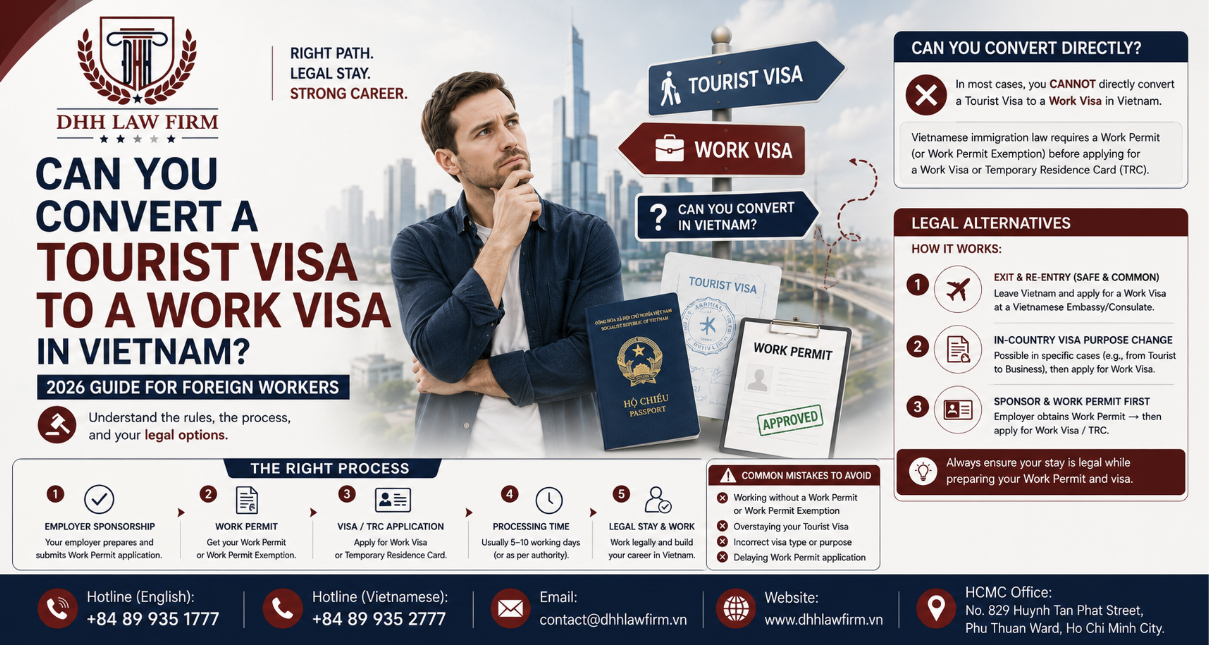
You Found a Job in Vietnam While on a Tourist Visa. What Now?
You entered Vietnam for a holiday. Then something unexpected happened. You received a job offer. The employer wants you to start soon, and someone tells you: “You’re already in Vietnam. Just change your tourist visa to a work visa.”
Is it really that simple? Not exactly.
Vietnamese immigration law does allow certain foreign nationals who entered Vietnam for tourism to have their visa purpose changed in specific circumstances. However, a tourist visa does not itself authorize employment, and changing the visa purpose does not replace the separate requirements for lawful employment.
This distinction is extremely important. Your situation involves two different questions:
- Can your immigration status be changed from tourism to employment?
- Are you legally authorized to work for the Vietnamese employer?
The first question concerns your visa.
The second may involve a Work Permit or Work Permit exemption.
Under the current labour framework, Decree 219/2025/ND-CP governs Work Permit procedures for foreign workers in Vietnam and has been effective since August 7, 2025.
At DHH LAW FIRM, we recommend solving these two issues together rather than assuming that obtaining a new visa automatically gives you the right to work.
Quick Answer: Can You Convert a Tourist Visa to a Work Visa?
Yes, in certain circumstances.
Vietnam’s immigration rules allow a foreigner who entered Vietnam for tourism to change the purpose of their visa in specific cases, including where the person is sponsored by an eligible Vietnamese agency, organization or employer and has the required Work Permit or confirmation that they are not subject to a Work Permit.
A foreigner who entered Vietnam using an e-visa may also be able to change the visa purpose where the applicable conditions are satisfied.
But there is an important sequence: Tourist Visa → Employment eligibility → Work Permit / exemption → Appropriate work visa
Not: Tourist Visa → Automatically become a worker
That distinction is the foundation of the entire process.
1. A Tourist Visa Does Not Allow You to Work
This is the first thing to understand. A Vietnamese tourist visa, generally classified as DL, is issued for tourism purposes. It is not an employment authorization.
So if you enter Vietnam as a tourist and then receive a job offer, you should not interpret your valid tourist visa as permission to begin working. The foreign worker must satisfy the applicable Vietnamese labour requirements.
Depending on the position and circumstances, this may mean obtaining a Work Permit or establishing that the worker falls within a statutory exemption. Only after the employment side has been properly addressed should the immigration status be considered.
2. When Is Conversion Actually Possible?
The key issue is not simply: “Do I have a tourist visa?”
It is: “Do I satisfy one of the legal conditions for changing the purpose of my stay?”
According to current guidance on Vietnam’s immigration rules, a tourist visa can be changed to an employment-related visa where the foreigner is sponsored by an eligible Vietnamese agency, organization or employer and has either: a valid Work Permit, or official confirmation that the person is not subject to a Work Permit.
A person who entered Vietnam on an e-visa may also fall within the permitted circumstances if the relevant employment requirements are satisfied. This means that simply having an employment contract is not necessarily enough.
The employer and foreign worker should first determine the appropriate labour authorization.
3. Work Permit First or Visa First?
The current public-service procedure allows the employer to submit a Work Permit application between 60 days and at least 10 days before the intended start date, and the competent authority generally has 10 working days after receiving a complete application to process it.
Therefore, don’t think of the visa as a substitute for the Work Permit.
4. What If I Qualify for a Work Permit Exemption?
This can make the process different. Vietnam’s current regulations recognize various categories of foreign workers who are not subject to a Work Permit under Decree 219/2025/ND-CP.
Depending on the exemption category, the employer may need: Confirmation that the worker is not subject to a Work Permit or, in certain cases, notification to the competent authority.
This means someone who is legally exempt from a Work Permit may still need documentation establishing that exemption before the immigration process can be completed. For example, a qualifying foreign spouse, investor or other exempt worker should not simply tell immigration: “I don’t need a Work Permit.”
They should be able to demonstrate why.
5. What Documents Are Usually Involved?
There is no single document checklist that applies to every foreign worker because the requirements depend on the employment arrangement. However, a typical case may involve several layers of documentation.
-
Employment side
- Passport
- Employment-related documents
- Health examination
- Criminal-record documentation where required
- Documents proving the worker’s position
- Documents proving the form of employment
- Work Permit or exemption documentation
Under the current Work Permit procedure, the application can include the employer’s prescribed application, health examination documentation, passport, criminal-record documentation, photographs and evidence concerning the foreign worker’s form of employment and position.
Immigration side
The foreign worker may then need documents supporting the appropriate visa-purpose change and sponsorship by the Vietnamese organization or employer. The exact immigration dossier should be checked according to the foreigner’s circumstances rather than copied from another case.
6. What If My Tourist Visa Is About to Expire?
This is where timing becomes critical. Suppose you have:
Tourist visa expiry: September 10
Job offer: September 1
Employer starts Work Permit process: September 2
You should not assume that the pending employment procedure automatically extends your legal stay. The Work Permit process and visa validity are separate matters.
If your tourist visa expires while you are waiting for the employment procedure, you may create a separate immigration problem. Therefore, if your visa is approaching expiry, tell the employer and immigration adviser immediately.
At DHH LAW FIRM, we recommend reviewing the visa expiry date at the beginning of the employment process, not after the Work Permit application has already been submitted.
7. Can You Start Working While the Visa Conversion Is Pending?
This is one of the most important questions. The safe answer is:
Do not start working simply because your employer has submitted an immigration application.
If you require a Work Permit, the Work Permit requirement still applies. If you are exempt, the applicable confirmation or notification requirements should still be addressed. A pending visa application does not automatically transform a tourist into an authorized employee. The current Work Permit procedure specifically requires the employer to submit the relevant application before the foreign worker’s intended working date.
Therefore: Visa application pending ≠ permission to work.
8. What Will the New Work Visa Be?
For foreign workers, the relevant visa categories generally include:
LD1 – For foreign nationals working in Vietnam who are not subject to a Work Permit, unless an applicable international treaty provides otherwise.
LD2 – For foreign nationals working in Vietnam who are required to have a Work Permit.
These categories are designed around the foreigner’s employment status. The maximum validity of a work visa is generally up to two years, subject to the applicable legal conditions. So the correct visa category depends on what happens on the employment side first.
9. What If You Entered Vietnam on an E-Visa?
This deserves separate attention because many foreign visitors now enter Vietnam using an electronic visa. An e-visa is not automatically a work authorization.
However, current immigration rules provide circumstances in which a person who entered Vietnam using an e-visa can change the visa purpose when the relevant employment conditions are satisfied.
So if you entered Vietnam on an e-visa and subsequently received a job offer, don’t immediately assume that you must leave Vietnam.
First determine:
- What is your current visa status?
- Who will sponsor you?
- Do you need a Work Permit?
- Are you exempt?
- Can your visa purpose legally be changed in your circumstances?
This assessment should happen before you make travel arrangements.
10. What If Conversion Is Not Available?
Not every tourist can simply change their status from DL to LD. If your circumstances do not satisfy the conditions for an in-country visa-purpose change, another legal route may be necessary. Depending on the case, this could involve:
Completing the Work Permit procedure and then following the appropriate immigration process
or
Leaving Vietnam and applying through the appropriate entry/sponsorship procedure
The correct option depends on your nationality, current immigration status, employer, Work Permit situation and the specific legal basis for the new visa.
11. The Biggest Misunderstandings
“My employer hired me, so I can start working.” – No. Employment authorization must be addressed separately.
“My tourist visa is still valid, so I can work until it expires.” – No. A valid tourist visa does not automatically authorize employment.
“The company is sponsoring me, so everything is legal.” – Sponsorship is important, but the foreign worker may still need a Work Permit or qualifying exemption.
“I have a Work Permit, so my tourist visa automatically becomes a work visa.” – Not automatically. Employment authorization and immigration status are separate matters.
“I can fix the visa after starting work.” – This can create unnecessary legal risk. The appropriate employment and immigration procedures should be addressed before work begins.
12. A Safer Process for Foreign Workers
The critical point is the final step:
Start working only after the employment authorization requirements have been properly addressed.
13. What If You Are Already Working on a Tourist Visa?
If you have already started working while holding a tourist visa, don’t ignore the situation. Continuing to work does not make the underlying issue disappear.
The correct response is to stop relying on assumptions and review:
- How long have you been working?
- What type of work are you performing?
- Who is your employer?
- Do you need a Work Permit?
- Do you qualify for an exemption?
- What is your current visa status?
- Can your immigration status be changed in Vietnam?
- Is another procedure required?
The appropriate solution depends on the facts. At DHH LAW FIRM, we can review the circumstances and determine the appropriate legal route rather than simply recommending that you “apply for a work visa.”
14. DHH LAW FIRM: From Tourist Status to Legal Employment
For foreigners who receive a job offer while visiting Vietnam, the biggest mistake is treating the matter as just a visa change.
In reality, the process may involve:
- Immigration status
- Work Permit
- Work Permit exemption
- Employer sponsorship
- Employment contract
- Supporting documents
- Visa / TRC
At DHH LAW FIRM, we can review these elements together. Our team can assess whether your circumstances may support a tourist-to-work visa purpose change, determine whether you need a Work Permit or qualify for an exemption, and help coordinate the relevant documentation with your employer.
If an in-country conversion is not available in your circumstances, DHH LAW FIRM can also advise on the appropriate alternative route rather than allowing you to remain in an uncertain immigration position.
The Key Question Is Not “Can I Change My Visa?”
The better question is:
“Can I legally transition from my current tourist status to employment in Vietnam without leaving my immigration status unresolved?”
Sometimes the answer is yes. Sometimes another procedure is required. And sometimes leaving Vietnam and completing the appropriate entry process is the safer option. The answer depends on the specific legal basis for your employment and immigration status.
Conclusion
If you entered Vietnam on a tourist visa and have now received a job offer, do not start working simply because you have found an employer. A tourist visa is not an employment authorization.
However, Vietnamese immigration rules do provide circumstances in which a foreigner who entered Vietnam for tourism—or in certain cases through an e-visa—can change the purpose of their visa to employment, provided the relevant legal conditions are satisfied.
At the same time, the foreign worker must address the separate requirements concerning a Work Permit or Work Permit exemption. Under the current labour framework, Decree 219/2025/ND-CP governs these procedures.
So the safest sequence is:
Check your visa → assess employment eligibility → obtain Work Permit/exemption documentation → confirm the appropriate immigration procedure → start working legally.
If you have received a job offer while in Vietnam on a tourist visa, DHH LAW FIRM can review your situation and help determine whether an in-country visa-purpose change is available or whether another legal route is more appropriate.
Frequently Asked Questions
-
Can I convert a tourist visa to a Work Visa in Vietnam?
→ In certain circumstances, yes. Vietnamese immigration rules allow a change of visa purpose for qualifying foreign nationals who meet the relevant sponsorship and employment requirements.
-
Can I work in Vietnam on a tourist visa?
→ A tourist visa is issued for tourism purposes and does not itself authorize employment. If you want to work legally, you need to satisfy the applicable Work Permit or exemption requirements.
-
Do I need a Work Permit before changing my visa to LD2?
→ If you are required to have a Work Permit, the employment authorization must be properly addressed. A visa application does not replace the Work Permit procedure.
-
What is the difference between LD1 and LD2?
→ LD1 is generally used for foreign workers who are not subject to a Work Permit, while LD2 is for foreign workers who are required to have a Work Permit.
-
Can I convert an e-visa to a work visa?
→ There are circumstances under which a foreigner who entered Vietnam on an e-visa can change the purpose of their visa when the relevant employment conditions are satisfied.
-
Can I start working while my Work Permit application is pending?
→ Do not assume that you can. The employer should complete the applicable Work Permit or exemption requirements before the foreign worker begins employment. The current Work Permit procedure requires the application to be submitted before the intended working date.
-
What if my tourist visa is about to expire?
→ Address the visa expiry immediately. A pending Work Permit application does not automatically extend your lawful stay in Vietnam.
Contact DHH Law Firm for Support
- Hotline (English): +84 89 935 1777
- Hotline (Vietnamese): +84 89 935 2777
- Email: contact@dhhlawfirm.vn
- Website: www.dhhlawfirm.vn
- HCMC Office: No. 829 Huynh Tan Phat Street, Phu Thuan Ward, Ho Chi Minh City.