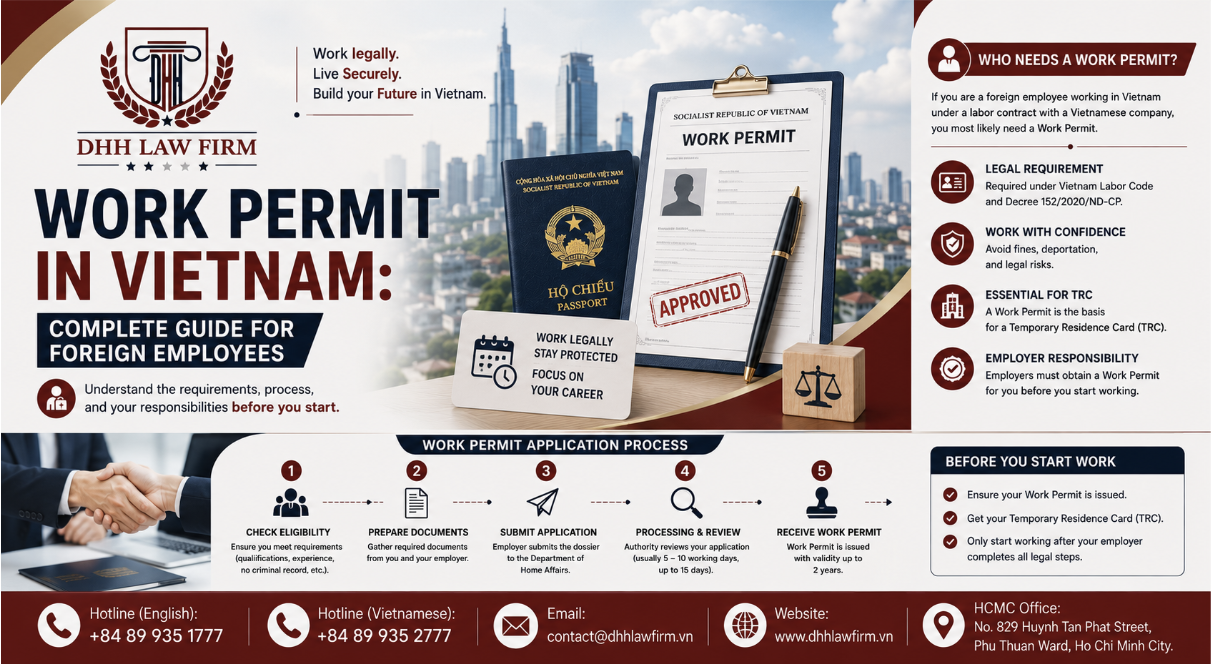
Work Permit in Vietnam: What Foreign Employees Need to Know
If you are a foreigner planning to work in Vietnam, one question comes before everything else: Do I need a Work Permit? For most foreign workers, the answer is yes—unless they fall within a statutory exemption.
Vietnam’s current framework is governed by Decree 219/2025/ND-CP, which took effect on August 7, 2025 and replaced the previous framework under Decree 152/2020 and Decree 70/2023.
The important thing is not simply obtaining a document. You need to make sure that:
your position → your qualifications → your employer → your Work Permit → your visa/residence status all match.
Foreign employee preparing Work Permit documents to legally work in Vietnam
1. Who Needs a Work Permit?
A foreign national working in Vietnam generally needs a Work Permit unless the person falls within one of the exemption categories provided by law.
The current regulations cover different forms of foreign employment, including foreigners working under employment contracts, being transferred within a company, performing service contracts, working for foreign contractors and other qualifying arrangements. Before applying, therefore, the first question should be:
Do I need a Work Permit—or am I exempt?
This matters because Vietnam currently recognizes a range of Work Permit exemption categories, including certain investors, foreign spouses of Vietnamese citizens, intra-company transferees and other specific cases. You should determine this before preparing a full Work Permit application.
2. What Does a Foreign Worker Need to Qualify?
The Work Permit process is built around the actual position the foreigner will perform. Depending on the position, you may need to demonstrate that you qualify as a:
- Manager
- Executive
- Expert
- Technical worker
The supporting evidence depends on the category. For example, professional qualifications, experience and documents proving the worker’s status may be required. This is why an old Work Permit cannot simply be copied into a new employment situation.
If you change your employer, position or form of employment, the appropriate procedure should be reassessed. The Government has specifically clarified that changing the position or form of work stated on an existing Work Permit can require a new Work Permit even where the employer remains the same.
3. What Documents Are Required?
Under the current regulations, the application generally revolves around a few key documents. The employer submits the prescribed application, together with supporting documentation such as:
| Document | Purpose |
| Employer’s application | Requests the Work Permit |
| Health examination | Confirms required health condition |
| Passport | Identity and travel document |
| Criminal record / equivalent document | Relevant background requirement |
| Qualification & experience documents | Proves the worker’s professional status |
| Employment-related documents | Establishes the form of employment |
| Other supporting documents | Depends on the specific position |
The current rules have simplified the process in some respects by integrating the employer’s explanation of the need to employ foreign workers into the Work Permit application.
Foreign-issued documents may also require consular legalization and Vietnamese translation, unless an applicable exemption applies.
4. Who Applies for the Work Permit?
This is important for foreign employees:
The employer handles the Work Permit application.
You normally do not walk into a government office and apply for your own Work Permit independently. The employer prepares and submits the application for the foreign worker.
Under the current framework, the competent provincial authority is responsible for Work Permit issuance, renewal, extension and related exemption confirmation within its jurisdiction. So, if you have just received a job offer, your first conversation should be with:
HR / Employer → Legal or Immigration Team → Work Permit Application
5. How Long Does It Take?
One of the biggest changes under Decree 219/2025 is the processing timeline. Once the competent authority receives a complete and valid application, the Work Permit decision is generally made within:
10 working days
If the authority does not approve the foreign worker or does not issue the Work Permit, it must provide a written explanation within the applicable period. But don’t interpret this as: “I can find a job today and start working tomorrow.”
The 10-working-day period applies after a complete application has been received. Preparing documents—particularly foreign qualifications, criminal records and legalized documents—can take considerably longer.
6. The Process in One Picture
For most foreign employees, the practical process looks like this:
The most important rule: Do not start working simply because you have signed an employment contract.
The employment contract and Work Permit serve different purposes.
7. What Happens After You Get the Work Permit?
Getting the Work Permit is not necessarily the final immigration step. Foreign workers may also need to review their:
- Visa
- Temporary Residence Card (TRC)
- Sponsor
- Residence registration
The immigration status should correspond to the person’s actual employment situation. For example, if you change employers, your Work Permit and immigration documents may need to be reassessed together.
8. What If You Don’t Need a Work Permit?
This is where many foreigners save themselves unnecessary paperwork. Vietnam has statutory Work Permit exemptions. But: Exemption does not always mean “no procedure.”
Depending on the category, the employer may need to obtain a confirmation that the foreign worker is not subject to a Work Permit, while certain categories only require notification to the competent authority.
So the correct question is not: “Can I avoid getting a Work Permit?” It is: “Which legal category applies to me?”
That assessment should be completed before the employee starts working.
9. What If You Change Employers?
Your Work Permit should not be treated as a general permission to work for any company in Vietnam. If you move from: Company A → Company B
The new employment relationship should be reviewed before you start the new job. The same applies if you remain with the same employer but change the position or form of work recorded on the Work Permit. In certain circumstances, a new Work Permit procedure is required. This is one of the most common areas where foreign workers rely too heavily on the expiry date printed on their existing Work Permit.
10. Three Things to Check Before Your First Working Day
If you are a foreign employee starting a new job in Vietnam, make sure these three questions have been answered:
① Do I need a Work Permit?
Or do I qualify for an exemption?
② Does my Work Permit match my actual job?
Check the employer, position and form of employment.
③ Does my visa/TRC match my employment?
A Work Permit does not automatically resolve your immigration status. If all three are aligned, you are in a much stronger position to start working legally.
How DHH LAW FIRM Can Help
For foreign employees, the difficult part is often not the Work Permit form itself. It is determining which procedure actually applies.
At DHH LAW FIRM, we can review your proposed employment arrangement and determine:
- whether a Work Permit is required;
- whether you qualify for an exemption;
- which documents are needed;
- whether foreign documents require legalization;
- whether a new Work Permit is required after changing employers or positions;
- and whether your visa or TRC also needs to be updated.
This approach helps avoid a common mistake: obtaining one document correctly while leaving another part of the foreign worker’s legal status unresolved.
Bottom Line
If you are a foreigner planning to work in Vietnam, don’t start with:
“How do I apply for a Work Permit?”
Start with:
“What is my correct legal route to work in Vietnam?”
You may need a Work Permit.
You may qualify for a Work Permit exemption.
Or your employment circumstances may require a different procedure.
Under the current Decree 219/2025/ND-CP, the Work Permit application process has been streamlined, with a 10-working-day processing period for a complete application.
But the most important step remains the same: Make sure your employment authorization is correct before you start working.
If you are unsure whether you need a Work Permit or exemption, DHH LAW FIRM can review your employment and immigration status and identify the appropriate route.
Frequently Asked Questions
-
How long does a Work Permit application take in Vietnam?
→ The competent authority generally has 10 working days from receipt of a complete application to process and issue the Work Permit.
-
Can I work in Vietnam without a Work Permit?
→ Only if you fall within a statutory exemption or another legally recognized situation. Some exemptions still require confirmation or notification.
-
Can I use my Work Permit after changing employers?
→ Do not assume that you can. A change of employer requires the new employment arrangement to be reviewed under the current regulations.
-
Does a Work Permit give me the right to stay in Vietnam?
→ Not by itself. Your Work Permit and immigration status—such as your visa or TRC—are separate matters.
-
Who applies for the Work Permit?
→ The employer submits the Work Permit application and supporting documents for the foreign worker.
- Hotline (ENG): +84 89 935 1777
- Hotline (VN): +84 89 935 2777
- Email: contact@dhhlawfirm.vn
- Website: www.dhhlawfirm.vn
- HCMC Office: Floor 2, 829 Huynh Tan Phat Street, Phu Thuan Ward, Ho Chi Minh City