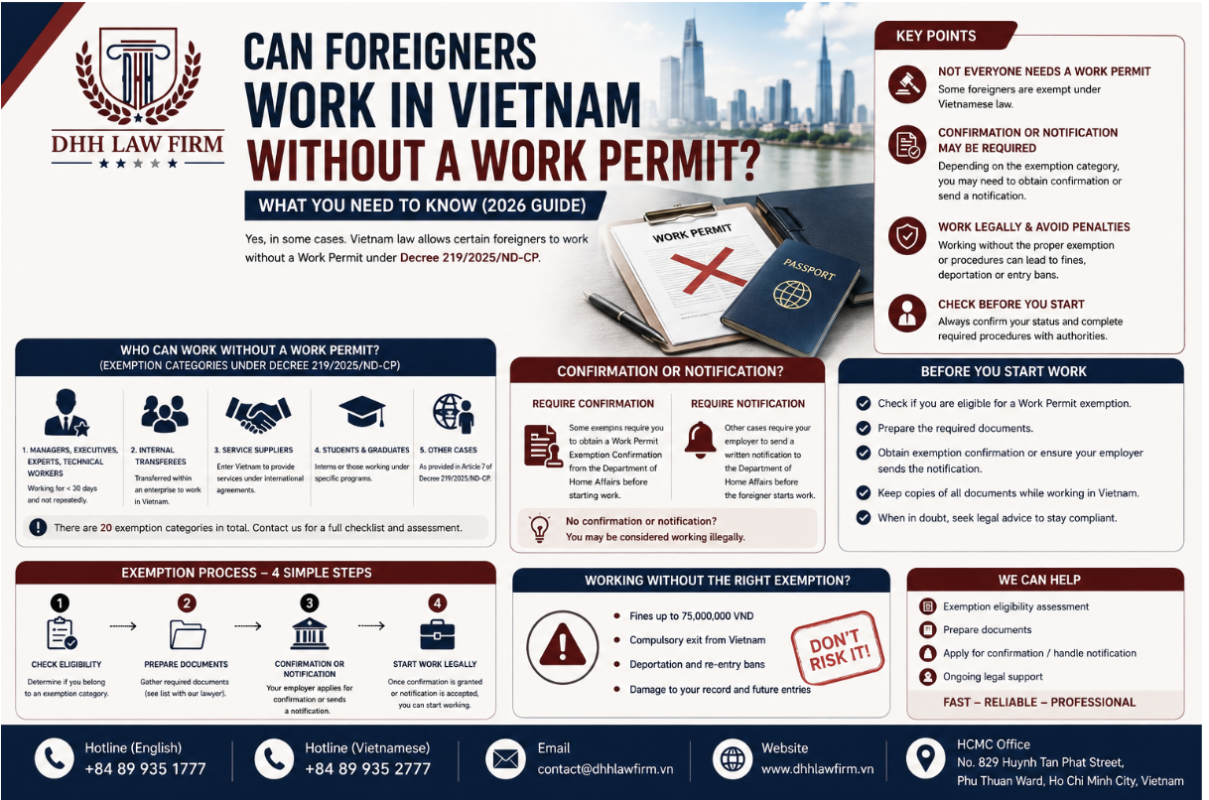
Can You Work in Vietnam Without a Work Permit?
If you are a foreigner planning to work in Vietnam, you may have already heard: “Foreigners need a Work Permit.” That is generally true—but it is not the whole story. Vietnamese law recognizes specific categories of foreign workers who are not subject to a Work Permit.
The current framework is Decree 219/2025/ND-CP, effective from August 7, 2025. It regulates Work Permit issuance, renewal, revocation and the procedures concerning foreign workers who are not subject to a Work Permit. It also replaced the previous framework under Decree 152/2020 and Decree 70/2023.
So the real question is not: “Can foreigners work without a Work Permit?” It is: “Do I fall within a legal exemption?”
1. Who Can Work Without a Work Permit?
Vietnam provides exemptions for specific groups of foreign workers. The categories are not based simply on nationality, salary or job title.
The important point is that each exemption has its own conditions.
Being an “expert” does not automatically mean you are exempt. Being an “investor” does not automatically mean you are exempt. And having a Vietnamese spouse does not mean that every immigration procedure disappears.
2. The Most Important Exemptions for Foreigners
Rather than trying to memorize every category, it is more useful to understand the situations foreigners most commonly encounter.
Foreign investors
Certain owners or capital-contributing members of an LLC, and certain JSC Board members, may be exempt when they meet the applicable capital-contribution requirements. Under the current rules, a qualifying LLC owner/member with capital contribution of at least VND 3 billion may fall within the exemption. Similar rules apply to certain JSC Board members meeting the applicable threshold.
Foreign spouses
A foreigner who is married to a Vietnamese citizen and living in Vietnam is among the categories not subject to a Work Permit.
Short-term foreign workers
Certain managers, executives, experts and technical workers working in Vietnam for a qualifying short period may fall within an exemption, subject to the statutory conditions.
Intra-company transferees
Certain employees transferred from an overseas company to its qualifying commercial presence in Vietnam may be exempt if the specific legal requirements are satisfied.
Other statutory categories
The regulations also cover specific cases involving education, diplomacy, volunteers, commercial presence establishment and other qualifying activities. The exact category should always be identified from the actual facts rather than from a job title alone.
3. Work Permit Exemption Does NOT Mean “No Paperwork”
This is the mistake we see most often. A foreign worker may genuinely be exempt from a Work Permit, but the employer may still have to complete an administrative procedure. Depending on the exemption category, the employer may need to obtain:
Confirmation of exemption or Notification to the competent authority
The current regulations distinguish between these procedures. For cases requiring confirmation, the employer must submit the application within the prescribed period before the expected start date; for certain categories that do not require confirmation, notification is required before the foreign worker starts working.
So: No Work Permit ≠ No legal procedure.
That distinction should be established before the employee starts working.
4. Can I Start Working Immediately If I Qualify for an Exemption?
Don’t assume that you can.
Suppose you qualify as a foreign spouse of a Vietnamese citizen. You might think:
“I don’t need a Work Permit, so I can start tomorrow.”
The exemption may remove the Work Permit requirement, but the applicable confirmation or notification procedure still needs to be considered. The same principle applies to investors, intra-company transferees and other exempt categories.
The safest sequence is:
This is one reason DHH LAW FIRM recommends assessing the exemption before the first working day, rather than after the employee has already started.
5. What Documents Prove the Exemption?
This depends entirely on why you are exempt.
For example:
Investor – Corporate records and evidence of the qualifying capital contribution may be relevant.
Foreign spouse – Documents establishing the marriage and relevant residence circumstances may be required.
Intra-company transferee – Evidence of the overseas employment relationship and qualifying transfer may be important.
Short-term expert – Documents establishing the worker’s position, qualifications and qualifying period of work may be relevant.
This is why there is no universal “Work Permit exemption document.” The evidence must match the specific legal exemption.
6. What About Foreign Investors?
This is particularly important for business owners. Many foreign investors assume:
“I’m the owner of the company, so I don’t need a Work Permit.”
That is too broad. The current rules provide specific investor-related exemptions, including qualifying LLC owners or capital-contributing members with at least VND 3 billion in capital contribution and certain JSC Board members meeting the applicable threshold. Therefore, the analysis should look at:
- Your investment amount
- Your corporate position
- The type of company
- What work you actually perform
rather than simply asking whether you are an “investor.” This also needs to be separated from your immigration status. An investor may qualify for a Work Permit exemption while separately needing an appropriate DT visa or Investor TRC.
7. What About Foreign Spouses?
This is another frequently overlooked exemption. A foreigner who is married to a Vietnamese citizen and living in Vietnam falls within a statutory Work Permit exemption under the current framework. That can make employment considerably simpler.
But there is an important distinction: Work Permit exemption does not automatically determine your visa or TRC.
Your residence status is a separate immigration issue. For example, a foreign spouse may have a family-based immigration status while being exempt from the Work Permit requirement.
8. What About Short-Term Work?
Another common assumption is:
“I’m only working in Vietnam for a few weeks, so I don’t need a Work Permit.”
That is not automatically correct. Certain short-term foreign workers may qualify for an exemption, but the regulation attaches conditions to the worker’s professional category and the nature and duration of the work.
So you should not simply count the number of days.
The correct approach is:
- What is your role?
- What work are you performing?
- How long will you work in Vietnam?
- Does your situation fit the statutory exemption?
If those conditions are satisfied, the appropriate exemption procedure can then be determined.
9. Can an Intra-Company Transferee Work Without a Work Permit?
In certain circumstances, yes. But this exemption is more specific than simply saying:
“I work for an international company.”
The legal requirements can involve the relationship between the foreign company and its Vietnamese commercial presence, the employee’s overseas employment history and the nature of the transfer. Therefore, an employee transferred from a foreign headquarters to Vietnam should have the corporate structure and employment history checked before relying on the exemption.
This is particularly important for multinational companies onboarding executives or technical specialists.
10. What If You Don’t Qualify for an Exemption?
Then you should proceed with the Work Permit route.
The current Decree 219/2025 framework regulates the application, issuance, renewal, extension and revocation of Work Permits for foreign workers in Vietnam.
For a foreign employee, the practical process becomes:
So an exemption assessment should happen before you spend time preparing a full Work Permit application.
11. Work Permit Exemption vs. Work Permit
| Work Permit Required | Work Permit Exemption | |
| Legal basis | Foreign worker does not qualify for an exemption | Worker falls within a statutory exemption |
| Main document | Work Permit | Exemption confirmation or applicable notification |
| Employer involvement | Yes | Yes |
| Can work immediately? | Not simply because an application is pending | Not necessarily; procedure must be checked |
| Visa/TRC | Separate issue | Separate issue |
The important takeaway: Both routes require legal assessment before employment begins.
12. What About the Visa or TRC?
This is where Work Permit exemption and immigration planning meet.
Even if you do not need a Work Permit, you still need an appropriate legal basis to enter and stay in Vietnam.
For example: Work Permit exemption → LĐ1 employment status → potentially LĐ1 TRC or: Investor exemption → DT status → Investor visa/TRC or: Foreign spouse exemption → family-based immigration status
Therefore, don’t treat: “I don’t need a Work Permit.”
as the end of the immigration process.
It may only answer the employment authorization question.
13. What Happens If You Work Without the Required Authorization?
This is where the risk becomes serious.
If a foreigner is not actually exempt and works without the required Work Permit, the person may face administrative consequences under Vietnamese law, while the employer may also face penalties for employing a foreign worker without the required authorization.
So the problem is not simply:
“I forgot to apply for a document.”
It can become a compliance issue affecting both the foreign worker and the employer.
That is why DHH LAW FIRM recommends verifying the exemption category before the employee starts working.
14. A Simple Test: Do You Need a Work Permit?
Ask these five questions:
1. What exactly will you do in Vietnam?
→ Job title alone is not enough.
2. Who will employ or engage you?
→ The Vietnamese entity and employment structure matter.
3. How long will you work?
→ Duration can be relevant to certain exemptions.
4. Do you fall within a statutory exemption?
→ Investor? Spouse? Intra-company transferee? Short-term expert? Other category?
5. What procedure proves your exemption?
→ Confirmation? Notification? Or a full Work Permit?
If you cannot answer question 4 and 5, don’t start working yet.
How DHH LAW FIRM Can Help
The biggest challenge in a Work Permit exemption in Vietnam case is usually not filling out a form. It is determining whether the foreign worker actually qualifies.
At DHH LAW FIRM, we can review:
- your nationality and status
- your employer
- your position
- your investment or employment relationship
- your qualifications and experience
- your expected working period
- your visa/TRC
- and supporting documents.
We then identify whether you should: apply for a Work Permit; obtain confirmation of exemption; or complete the applicable notification procedure.
If the worker is an investor, foreign spouse, executive, expert or intra-company transferee, DHH LAW FIRM can assess the specific exemption category rather than applying a generic checklist.
Bottom Line
Yes, foreigners can work in Vietnam without a Work Permit—but only when they fall within a legally recognized exemption or other applicable category.
Under the current Decree 219/2025/ND-CP, Vietnam has specific rules for foreign workers who are not subject to a Work Permit, as well as separate procedures for confirming exemption status.
The safest approach is:
Check eligibility → prove the exemption → complete the required procedure → then start working.
Don’t rely on statements such as: “My friend works without a Work Permit.”
or: “I’m an investor, so I don’t need one.”
Your exemption depends on your own legal circumstances.
If you are unsure whether you can work in Vietnam without a Work Permit, DHH LAW FIRM can assess your situation and identify the correct employment and immigration route.
Frequently Asked Questions
-
Can foreigners work in Vietnam without a Work Permit?
→ Yes, in specific circumstances. Vietnam’s regulations provide statutory exemptions for certain categories of foreign workers. The worker must satisfy the conditions of the applicable exemption.
-
Who is exempt from a Work Permit in Vietnam?
→ The exemptions cover specific groups, including qualifying investors, foreign spouses of Vietnamese citizens, certain intra-company transferees, short-term qualifying workers and other categories provided by law.
-
Do Work Permit-exempt foreigners need any documents?
→ Possibly. Depending on the category, the employer may need to obtain confirmation that the worker is not subject to a Work Permit or complete a notification procedure.
-
Can I start working while waiting for exemption confirmation?
→ You should not assume that you can. If your exemption category requires confirmation, the applicable procedure should be completed before employment begins.
-
Are foreign investors exempt from Work Permits?
→ Some are. The current rules provide specific exemptions based on the investor’s corporate position and qualifying capital contribution. Being an “investor” alone is not enough.
-
Are foreign spouses exempt from Work Permits?
→ A foreigner married to a Vietnamese citizen and living in Vietnam is among the statutory exemption categories.
-
Does Work Permit exemption mean I can stay in Vietnam without a visa?
→ No. Employment authorization and immigration status are separate issues. You still need an appropriate legal basis to stay in Vietnam.
- Hotline (ENG): +84 89 935 1777
- Hotline (VN): +84 89 935 2777
- Email: contact@dhhlawfirm.vn
- Website: www.dhhlawfirm.vn
- HCMC Office: Floor 2, 829 Huynh Tan Phat Street, Phu Thuan Ward, Ho Chi Minh City