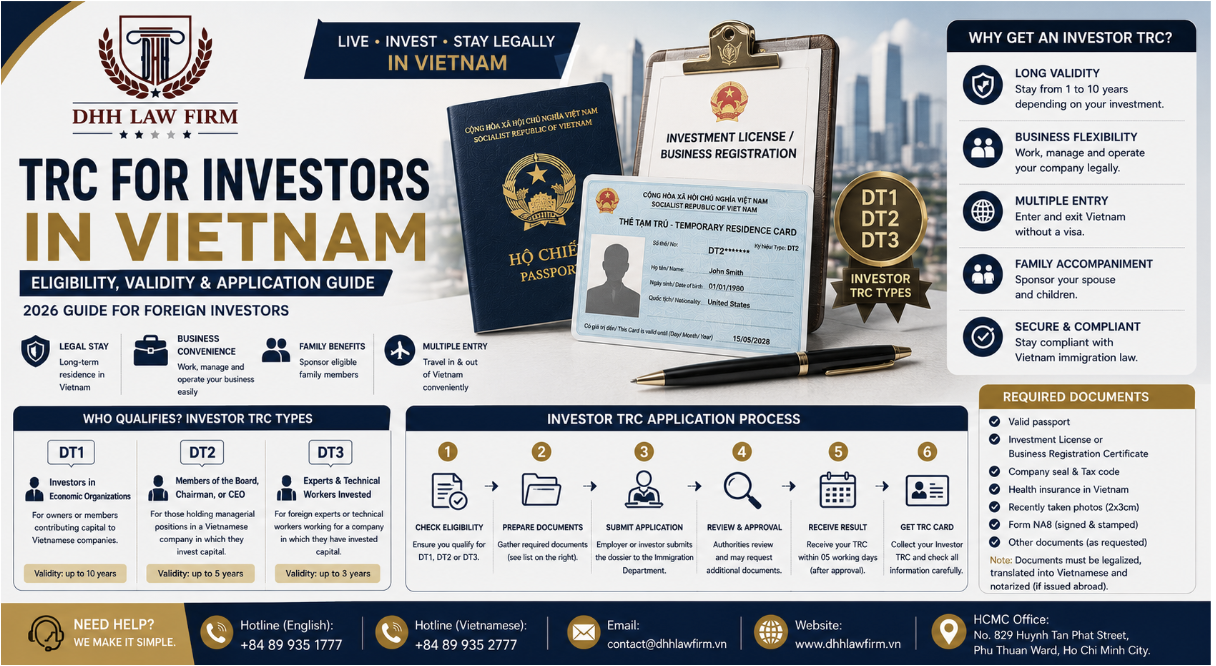
TRC for Investors in Vietnam: What Foreign Investors Need to Know
For a foreign investor, a Temporary Residence Card (TRC) can be much more practical than repeatedly applying for short-term visas. But there is an important point: Not every foreign investor automatically qualifies for the same type of TRC.
Your investment amount determines the relevant investor immigration category. Under the current immigration framework, investor visas are divided into DT1, DT2, DT3 and DT4, while investor TRCs are available for qualifying DT1, DT2 and DT3 holders.
So the first question is not: “How do I apply for a TRC?” It is: “Which investor category applies to me?”
Foreign investor preparing documents for a Temporary Residence Card in Vietnam
1. Which Investor TRC Can You Get?
The investor categories are based primarily on the value of the foreigner’s capital contribution or the applicable investment classification.
| Investor category | Investment level | Maximum visa validity | TRC |
| DT1 | VND 100 billion or more, or qualifying specially encouraged investment | Up to 5 years | Up to 10 years |
| DT2 | VND 50 billion to under VND 100 billion, or qualifying encouraged investment | Up to 5 years | Up to 5 years |
| DT3 | VND 3 billion to under VND 50 billion | Up to 3 years | Up to 3 years |
| DT4 | Under VND 3 billion | Up to 1 year | No investor TRC category |
The current law specifically provides that DT1, DT2 and DT3 are eligible for Temporary Residence Cards, while DT4 is not included among the categories eligible for an investor TRC.
The practical takeaway: VND 3 billion is an important threshold.
An investor contributing less than VND 3 billion may still have an investor visa, but should not assume that this automatically provides eligibility for an investor TRC.
2. How Long Is an Investor TRC Valid?
The maximum validity depends on the investor category.
DT1 TRC – Up to 10 years
DT2 TRC – Up to 5 years
DT3 TRC – Up to 3 years
However, there is another limitation: The TRC must be shorter than the remaining validity of the passport by at least 30 days.
So even if you qualify for a 5-year or 10-year TRC, you should check your passport validity before applying. A long-term investment status does not override the passport-validity requirement.
3. What Does an Investor TRC Actually Give You?
The biggest advantage is simple: Long-term lawful residence in Vietnam
Instead of repeatedly managing short-term visas, an eligible investor can use the TRC as evidence of temporary residence for the period stated on the card.
This can make daily life considerably easier for investors who:
- operate a Vietnamese company
- manage their investment
- travel in and out of Vietnam
- maintain long-term residence
- need a stable immigration status
But the TRC should not be confused with a Work Permit. Your immigration status and your employment authorization are separate legal matters.
4. Investor TRC vs Investor Visa
This distinction is important. An investor may have a DT visa without necessarily having an investor TRC. For example:
DT4: Investor visa may be available, but DT4 is not among the categories eligible for a Temporary Residence Card.
DT3: Investors may qualify for both the DT3 visa and a DT3 TRC, subject to the applicable conditions.
Therefore: Investor visa ≠ automatically Investor TRC. The investment category needs to be checked first.
5. What Documents Are Needed?
The exact application package depends on the investor’s circumstances and the sponsoring entity. Under the immigration law, an application for a Temporary Residence Card generally includes:
- Sponsoring organization’s application
- Application form for the TRC
- Valid passport
- Documents proving eligibility for the relevant TRC category
For investors, this means the corporate and investment documents become particularly important. The authorities may need evidence establishing the investor’s relationship with the Vietnamese company and the relevant investment category. This is why the corporate records should be reviewed before submitting the immigration application.
6. How Does the Application Process Work?
Under the current law, the inviting or sponsoring organization submits the application to the immigration authority where the organization is headquartered. Once a complete application is received, the immigration authority generally considers the TRC application within 5 working days.
7. Can a Foreign Investor Work in Their Own Company?
This is where investors often confuse investment status with employment status. Having an investor TRC does not, by itself, answer every question concerning whether the foreign investor is subject to Vietnam’s Work Permit rules.
The investor’s corporate position, capital contribution and actual work performed need to be assessed under the current labour regulations.
For example, under Decree 219/2025/ND-CP, certain LLC owners or capital-contributing members with capital contributions of at least VND 3 billion, and certain JSC Board members meeting the applicable capital threshold, are among the foreign workers not subject to a Work Permit.
So the correct analysis is: Investment status → TRC eligibility and separately:
Corporate position + capital contribution + actual work → Work Permit / exemption
Do not treat the TRC as a substitute for the Work Permit analysis.
8. What If Your Investment Changes?
This is another issue investors should monitor. Suppose you originally qualified as DT3.
Later, your investment structure changes. Or your capital contribution increases significantly. Your immigration category may need to be reassessed.
Likewise, if you transfer your investment or cease to maintain the underlying investment relationship, you should not simply continue assuming that your existing investor TRC remains appropriate until its printed expiry date.
The immigration status should correspond to the underlying legal basis.
9. Investor TRC vs. Other TRC Categories
The investor TRC is only one route to temporary residence. Depending on the foreigner’s circumstances, other TRC categories include:
- LĐ1 / LĐ2 — employment-related residence
- TT — certain family relationships
- DH — study
- LS — foreign lawyers
- LV categories — certain diplomatic, governmental or organizational activities
The important point is: Your TRC category should match the legal basis for your residence in Vietnam.
If your circumstances change, your immigration status may need to change with them.
10. Common Mistakes Investors Make
Mistake 1 — Assuming every investor gets a TRC
Not all investor categories qualify. DT4 investors are not among the investor TRC categories.
Mistake 2 — Looking only at the visa expiry date
Passport validity can limit the maximum TRC duration.
Mistake 3 — Treating a TRC as a Work Permit
A residence document and employment authorization are different matters.
Mistake 4 — Ignoring changes to the investment structure
A change in capital contribution or corporate position can affect the immigration basis.
Mistake 5 — Waiting until the TRC expires
The investor should review renewal or a new application before the existing residence status becomes problematic.
How DHH LAW FIRM Can Help Investors
For investors, the TRC application is closely connected to the company’s corporate and investment records. At DHH LAW FIRM, we can review:
- Capital contribution
- Investment registration documents
- Company records
- Investor’s corporate position
- Passport validity
- Current DT visa / TRC
- Work Permit or exemption status
Based on these documents, DHH LAW FIRM can determine the appropriate investor immigration category and assist with the TRC application. We can also review the investor’s immigration + employment status together, which is particularly important when the investor is actively managing or working for their Vietnamese company.
The Bottom Line
For a foreign investor, an Investor TRC in Vietnam can provide a much more stable basis for long-term residence. But the correct TRC depends on your investment category:
- DT1 → TRC up to 10 years
- DT2 → TRC up to 5 years
- DT3 → TRC up to 3 years
- DT4 → investor visa available, but no investor TRC category.
The TRC application itself can be relatively straightforward when the investment and corporate documents are properly prepared.
The difficult part is making sure that the investment structure, immigration category and employment status all tell the same legal story.
If you are a foreign investor planning to live in Vietnam long term, DHH LAW FIRM can review your investment structure and current immigration status and help determine the appropriate TRC route.
Frequently Asked Questions
-
Who can get an Investor TRC in Vietnam?
→ Foreign investors holding qualifying DT1, DT2 or DT3 status may be eligible for an investor TRC, subject to the applicable requirements.
-
Can a DT4 investor get a TRC?
→ The current law lists DT1, DT2 and DT3 among the investor categories eligible for Temporary Residence Cards. DT4 is not included.
-
How long is an Investor TRC valid?
→ The maximum period is 10 years for DT1, 5 years for DT2 and 3 years for DT3, subject also to the passport-validity limitation.
-
How long does the TRC application take?
→ The immigration authority generally considers a complete TRC application within 5 working days.
-
Does an Investor TRC allow me to work in Vietnam?
→ Not automatically. TRC status and Work Permit status are separate issues. Whether an investor needs a Work Permit or qualifies for an exemption should be assessed separately.
-
Can I renew my Investor TRC?
→ An expired TRC may be considered for issuance of a new card, subject to the investor continuing to satisfy the applicable conditions.
- Hotline (ENG): +84 89 935 1777
- Hotline (VN): +84 89 935 2777
- Email: contact@dhhlawfirm.vn
- Website: www.dhhlawfirm.vn
- HCMC Office: Floor 2, 829 Huynh Tan Phat Street, Phu Thuan Ward, Ho Chi Minh City