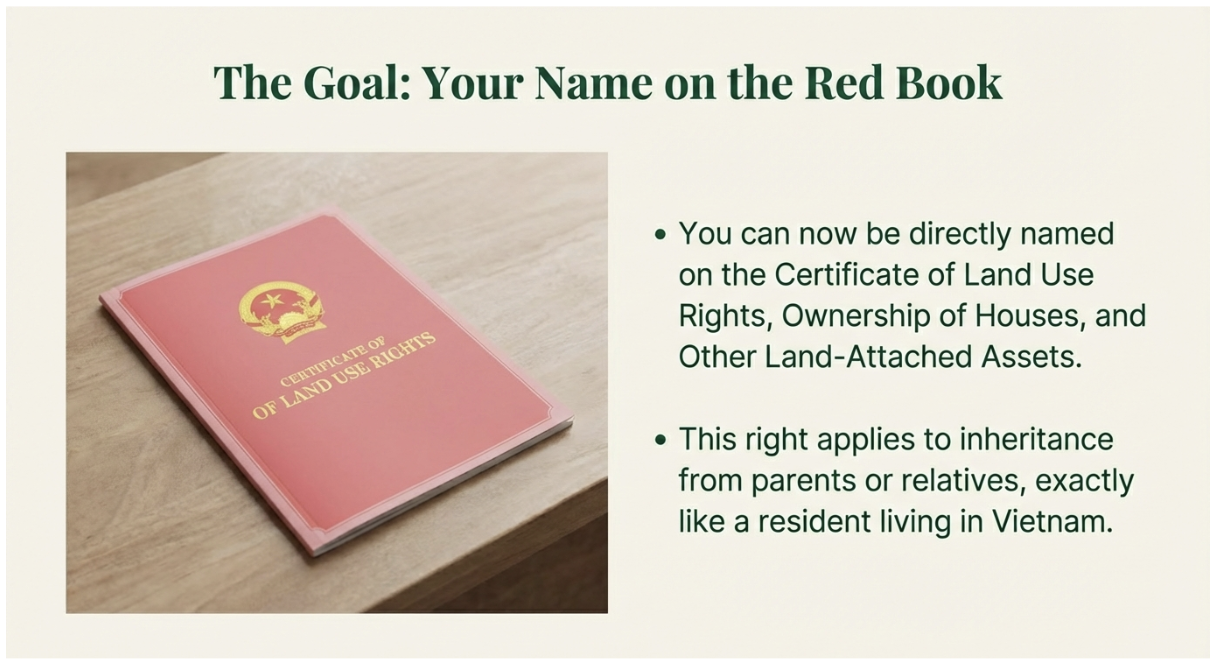
The latest changes to the Land Law and the Law on Housing have brought excellent news for our overseas compatriots. If you are wondering about the estate left by your parents or relatives in your homeland but fear that lacking Vietnamese citizenship or a household registry will prevent you from keeping the land, this article will provide detailed answers.
Below is the legally standardized 2026 guide on Overseas Vietnamese inheriting land and the regulations for foreigners inheriting housing and land in Vietnam.
1. Updates on the New Land Law for Overseas Vietnamese (People of Vietnamese Origin Residing Abroad)
Previously, the land use rights of Overseas Vietnamese were quite restricted. However, under the 2024 Land Law and the 2023 Law on Housing (which have officially taken effect and are fully implemented in 2026), legal policies have maximized the rights of overseas compatriots.
Specifically, current law stipulates that people of Vietnamese origin residing abroad are granted land use rights completely equal to domestic Vietnamese citizens.
This means:
- You have the full right as an Overseas Vietnamese inheriting land (including residential land, agricultural land, commercial/service land, etc.) from parents or relatives, exactly like someone living in Vietnam.
- You can be directly named on the Certificate of Land Use Rights, Ownership of Houses and Other Land-Attached Assets (commonly known as the Red Book/Pink Book) without having to ask a relative in Vietnam to hold the title on your behalf (a practice that inherently carries significant risks of disputes).
2. Conditions for Overseas Vietnamese to be Directly Named on the Certificate (Red Book)
Although the law has expanded these rights, to actually hold a Red Book bearing your name, you must satisfy the following two core conditions:
- First, be permitted to enter Vietnam: You must hold a valid Vietnamese Passport or a foreign passport with a valid Vietnamese visa or visa exemption certificate to prove you are legally allowed to enter the territory of Vietnam.
- Second, possess documents proving Vietnamese origin: If you use a foreign passport, you must have documents proving you are of Vietnamese descent (e.g., Certificate of Vietnamese Origin, Birth Certificate, or documents proving the previous Vietnamese citizenship of yourself, your parents, or your grandparents).
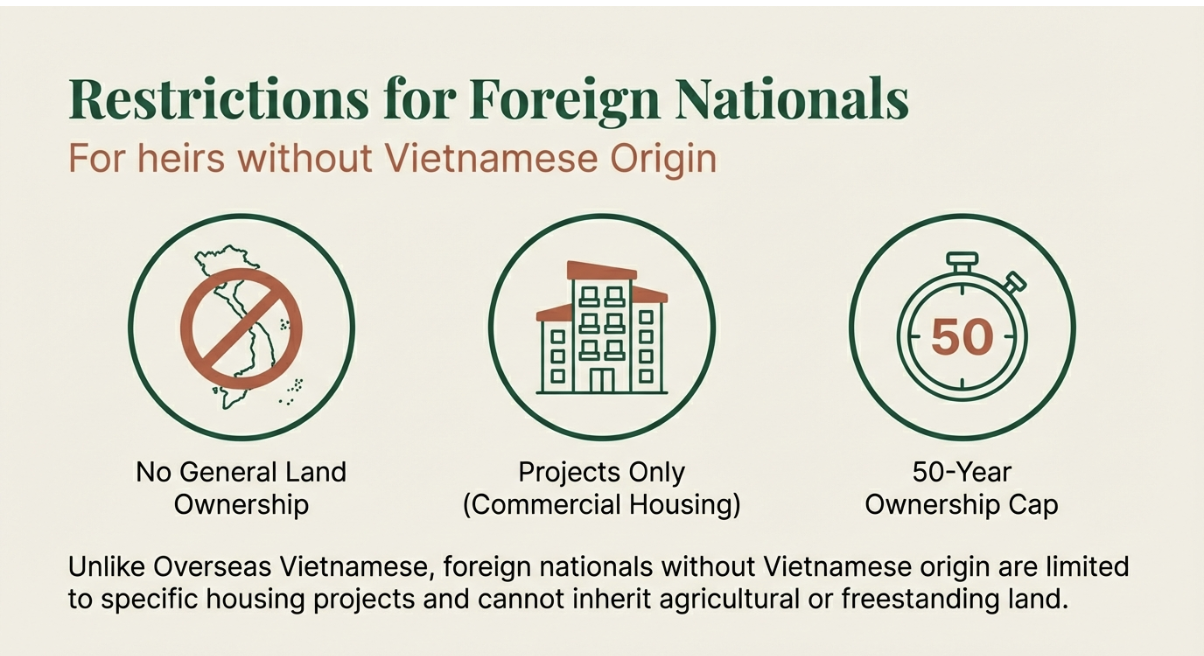
Note for Foreign Nationals (Without Vietnamese Origin): Unlike Overseas Vietnamese, the laws regarding foreigners inheriting housing and land are much stricter. Foreign nationals are not entitled to general “land ownership” (land use rights). They are only permitted to inherit housing (apartments or individual houses) located within commercial housing construction investment projects, and the ownership duration is typically limited (usually a maximum of 50 years).
3. Legal Solutions When Ineligible to be Named on the Title (Enjoying the Property Value Only)
In reality, there are many cases where second or third-generation overseas compatriots (F2, F3) cannot extract documents proving their Vietnamese origin, or the heir is a foreign national (e.g., the foreign spouse of a Vietnamese citizen).
If you fall into the category of those ineligible to be directly named on the Red Book, the 2026 law provides solutions to protect your property rights as follows:
You are Entitled to the Full “Value” of the Estate
Even without holding the Red Book, you absolutely do not lose this property. You have the right to dispose of the inherited assets through two methods:
- Transfer (Sell) to another person: You can authorize a relative in Vietnam or personally carry out the procedure to sell the land/house to an eligible buyer in Vietnam, and subsequently receive the entire proceeds from the sale.
- Gift the estate: You have the right to legally gift your inherited portion of the estate to a relative in Vietnam (who is eligible to receive it) so they can directly hold the title to the Red Book.
During the Period Before Selling or Gifting
- If you have not yet found a buyer, the land/house remains under your management. You (or your authorized representative) can lease it and collect yields and profits from that real estate.
- The State will not recover (expropriate) this land simply because you are ineligible to be named on the title. The land administration system will clearly note that you are the lawful heir but do not yet meet the conditions for Certificate issuance.
📞 Contact DHH Law Firm Today
If you have any questions or require legal assistance regarding Work Permits, please contact DHH Law Firm:
🏢 Main Office: 2nd Floor, 829 Huynh Tan Phat Street, Phu Thuan Ward, Ho Chi Minh City, Vietnam
📞 Hotline:
- +84 89 9352 777 (Vietnamese)
- +84 89 9351 777 (English)
🌐 Website: www.dhhlawfirm.vn
📧 Email: contact@dhhlawfirm.vn
✨ DHH Law Firm – Your trusted legal partner for family and foreign-related civil procedures in Vietnam.