Going through a divorce is inherently stressful, but getting a divorce when your husband/wife is abroad and unable to return to Vietnam is even more complex due to distance and legal barriers. Many people feel stuck, not knowing where to file the petition, how the Court will contact the party abroad, or worrying that the other party will intentionally evade the process.
This article provides a detailed guide on the process, required dossier, and how to handle a divorce in absentia with a foreign element according to current laws, helping you resolve these issues swiftly.
1. Which Court has jurisdiction over divorce cases with a foreign element?
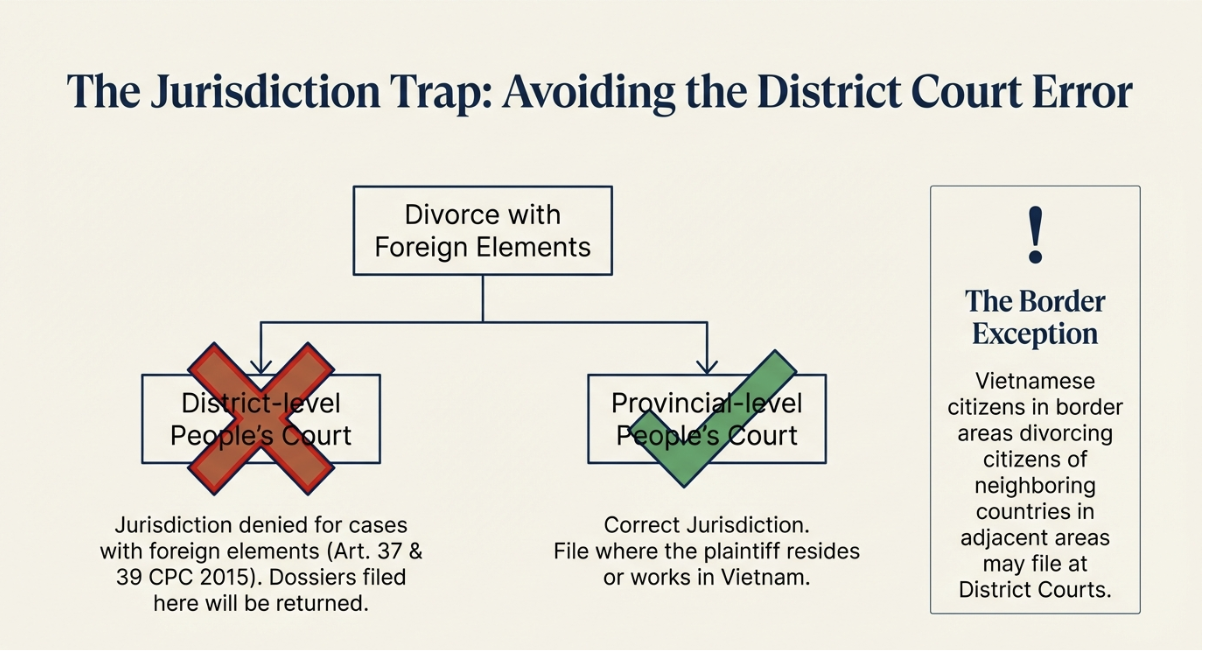
According to Articles 37 and 39 of the 2015 Civil Procedure Code (CPC), the jurisdiction to resolve divorce cases with a foreign element (where one litigant is abroad) does not belong to the District-level People’s Court, but rather to:
- The Provincial-level People’s Court: Where the plaintiff (the person filing the petition) resides or works in Vietnam.
- Exception: If the divorce involves a Vietnamese citizen residing in a border area and a citizen of a neighboring country residing in the adjacent border area with Vietnam, the District-level Court where the Vietnamese citizen resides has jurisdiction.
Note: You must file your petition with the Provincial Court of your permanent or temporary residence. Do not mistakenly file it at the District level, as your dossier will be returned, causing unnecessary delays.
2. Required Dossier for Divorce in Absentia
For the Court to accept and process a case of divorce in absentia with a foreign element, you need to prepare a complete dossier including:
- Petition for Divorce (for unilateral divorce) or Request for Recognition of Mutual Consent Divorce (for mutual consent divorce).
- Original Certificate of Marriage Registration.
- Certified copies of the Identity Card / Passport of the petitioner and the party residing abroad (if available).
- Certified copies of the Birth Certificates of common children (if any).
- Documents proving common marital property and joint debts (if requesting the Court’s settlement).
- MOST IMPORTANTLY: Documents and evidence proving the current residential address and workplace of the spouse abroad. This is a mandatory basis for the Court to conduct the service of legal documents.
3. How to Serve Documents Abroad (Judicial Delegation)
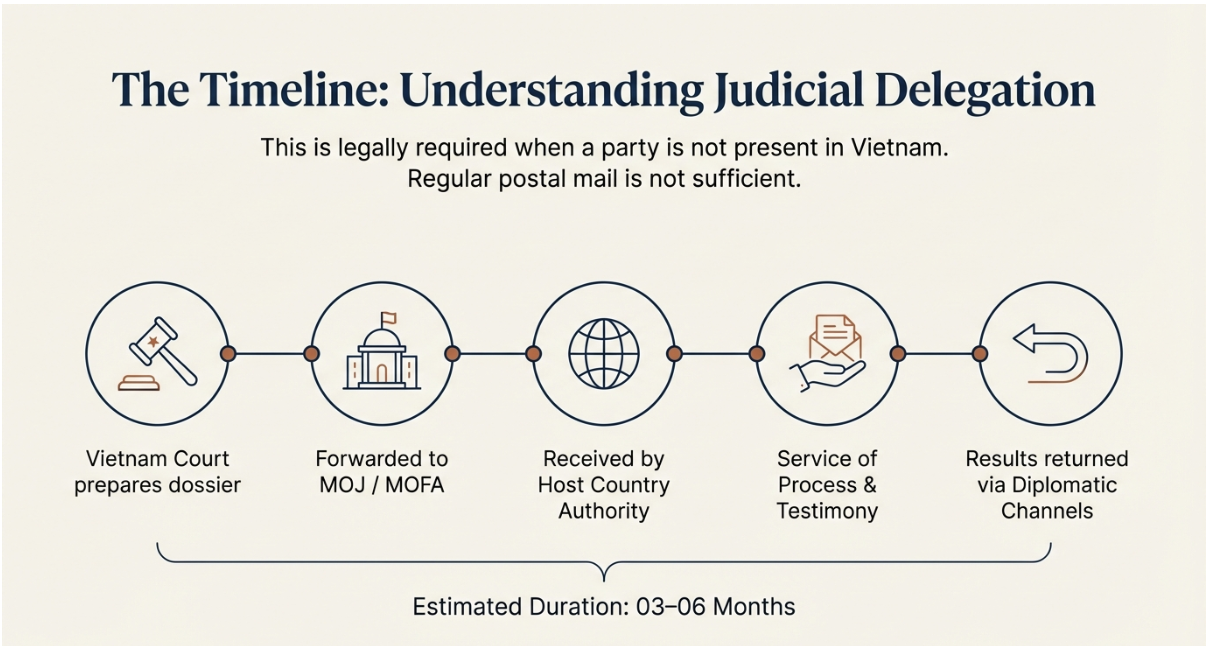
When one party is not present in Vietnam, the Court cannot send summons via regular postal mail. Instead, it must strictly carry out the Judicial Delegation (Mutual Legal Assistance) procedure. This is usually the most time-consuming phase in a divorce when the husband/wife is abroad.
The Judicial Delegation process generally proceeds as follows:
- Step 1: The Vietnamese Court prepares a judicial delegation dossier and sends it to the Ministry of Justice or the Ministry of Foreign Affairs of Vietnam.
- Step 2: The Ministry of Justice / Ministry of Foreign Affairs forwards this dossier to the competent authority of the host country (where the spouse is residing).
- Step 3: The foreign authority serves the documents to that individual, takes their testimonies/opinions, and sends the results back to Vietnam via diplomatic channels.
Processing Time: Judicial delegation typically takes from 03 to 06 months, or even longer depending on whether Vietnam and the host country have signed a Mutual Legal Assistance Agreement.
4. How to Handle Cases Where the Other Party is Uncooperative or Conceals Their Address
One of the biggest risks of a divorce in absentia with a foreign element is that the opposing party refuses to provide their address, ignores the Court’s documents, or intentionally conceals their whereabouts. Current laws provide specific solutions for each scenario:
Scenario 1: A specific address is available, but the opposing party does not respond
If the Court has properly conducted the judicial delegation but the person abroad intentionally fails to provide testimonies or attend the hearing, the Vietnamese Court will proceed with a trial in absentia pursuant to Article 474 of the 2015 CPC. You can still successfully obtain a divorce even if the other party does not cooperate.
Scenario 2: The address of the person abroad is unknown (Intentional concealment)
If the relatives of the person abroad refuse to provide the address, the Court will require you to contact competent authorities (such as the Immigration Department) to gather evidence of their exit from Vietnam. If it is determined that the person is intentionally concealing their address, the Court will bring the case to a trial in absentia.
Scenario 3: The defendant is truly missing
If all search measures have been exhausted (via diplomatic channels, mass media announcements) and there is still no trace of them, you must carry out a separate procedure to Request the Court to declare a person missing. Once the decision declaring the person missing takes legal effect, the Court will grant your divorce.
📞 Contact DHH Law Firm Today
If you have any questions or require legal assistance regarding Work Permits, please contact DHH Law Firm:
🏢 Main Office: 2nd Floor, 829 Huynh Tan Phat Street, Phu Thuan Ward, Ho Chi Minh City, Vietnam
📞 Hotline:
- +84 89 9352 777 (Vietnamese)
- +84 89 9351 777 (English)
🌐 Website: www.dhhlawfirm.vn
📧 Email: contact@dhhlawfirm.vn
✨ DHH Law Firm – Your trusted legal partner for family and foreign-related civil procedures in Vietnam.