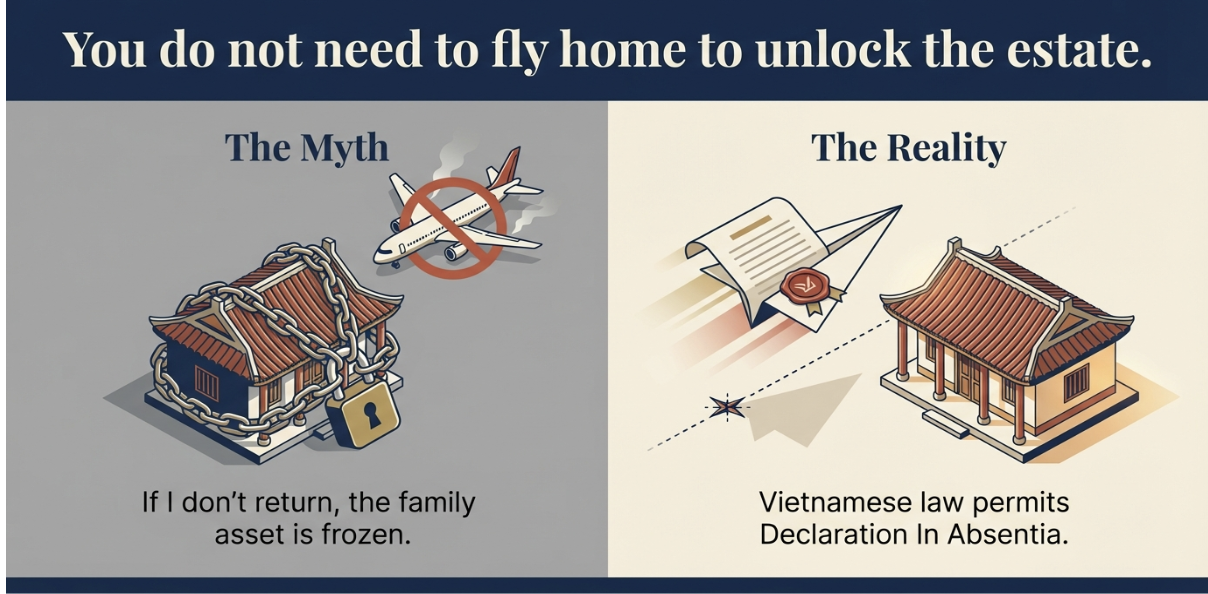
Is your family trying to transfer the title or sell a house left by your parents, but you are stuck because a sibling is residing overseas and cannot fly back to Vietnam to sign the paperwork? Many people worry that this situation will leave the estate permanently “frozen.”
In reality, Vietnamese law provides very clear regulations for declaring inheritance in absentia. Your relative absolutely does not need to waste time and money flying back to the country. The article below provides a detailed guide on how to legally, safely, and swiftly process an inheritance involving an heir abroad.
1. Legal Solutions for the Heir Abroad: Power of Attorney or Disclaimer of Inheritance
Under the Civil Code, all co-heirs have equal rights. A notarial practice organization in Vietnam cannot establish a Document of Inheritance Acceptance or an Agreement on the Division of Estate without the signatures or official consent of every legal heir.
To resolve the issue of absentee inheritance declaration, the person residing abroad can choose one of the following two solutions:
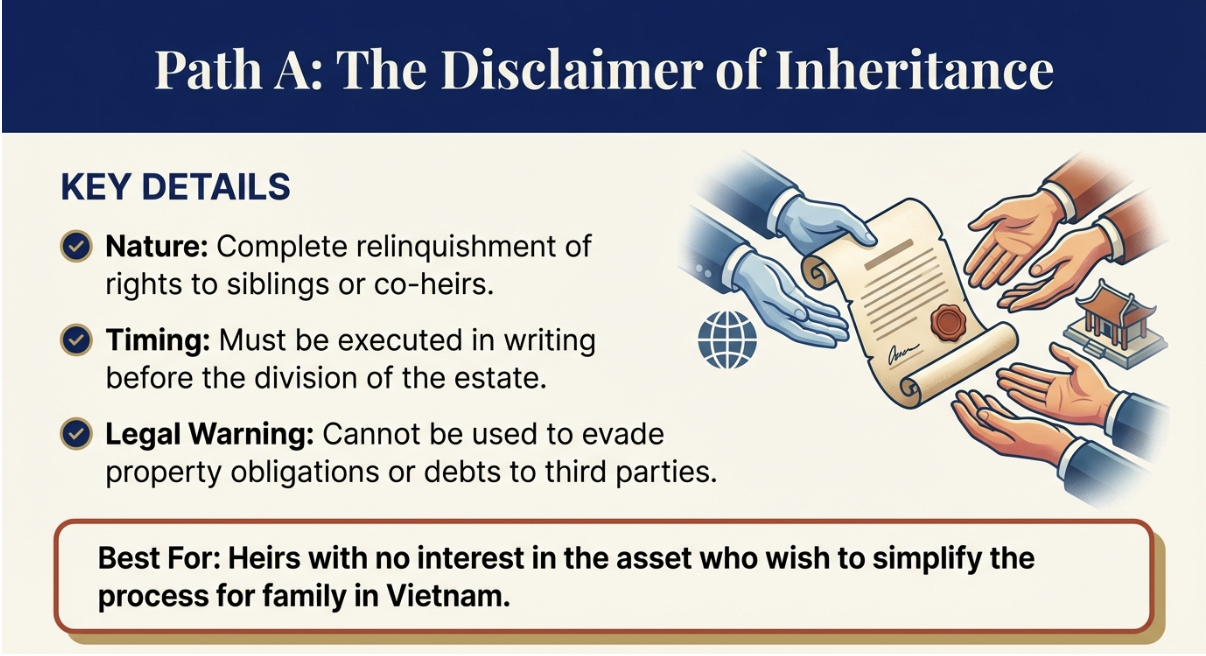
Option 1: Executing a Disclaimer of Inheritance
- Nature: The heir abroad voluntarily relinquishes their entire share of the estate to their siblings or other co-heirs in Vietnam.
- Crucial Legal Note: The refusal must be made in writing before the division of the estate. More importantly, this disclaimer must not be for the purpose of evading property obligations (e.g., dodging debts) to third parties.
Option 2: Executing a Power of Attorney (POA)
- Nature: The heir abroad still accepts their share of the estate (or agrees to sell it to divide the proceeds), but they authorize a representative in Vietnam (who can be another co-heir) to sign documents at the notary office and carry out the title transfer procedures on their behalf.
- Scope of Authorization: This must be extremely detailed (e.g., authorized to sign the agreement on estate division, authorized to sign the sales contract, authorized to receive funds, etc.).
2. Drafting and Consular Legalization Process to Send Documents to Vietnam
Documents created abroad cannot simply be mailed to Vietnam and used immediately. For the documents to hold legal validity in Vietnam, the heir abroad must follow this sequence:
- Step 1: Draft the document: Prepare the draft Power of Attorney or Disclaimer of Inheritance. (It is highly recommended to have a Notary Public in Vietnam draft the standard template and email it over to avoid any phrasing errors).
- Step 2: Sign and authenticate abroad: There are two ways to do this:
- Method A (Fastest, highly recommended): Bring the draft directly to the Vietnamese Embassy / Consulate in the host country and sign it in front of the Consular Officer. This document can be sent straight to Vietnam for immediate use.
- Method B (If far from the Embassy): Sign and have it notarized by a local Notary Public in the host country.
- Step 3: Consular Legalization (Only applies to Method B): Documents notarized by a foreign authority must be taken to that country’s Ministry of Foreign Affairs (or equivalent) for certification, and then brought to the Vietnamese Embassy for Consular Legalization.
- Step 4: Mail the original physical documents (complete with all official seals/stamps) via international courier (DHL, FedEx, etc.) to the family in Vietnam.
Pro Tip: To ensure the process of an inheritance involving an heir abroad goes smoothly, the overseas heir should enclose certified true copies of their Passport, Green Card/Visa, and Birth Certificate when mailing the dossier back to Vietnam.
3. The Procedure for Public Posting and Notarization in Vietnam
Once the family in Vietnam receives the dossier mailed from abroad, the inheritance declaration process will follow the standard sequence under the Law on Notarization:
Step 1: Submit the Dossier to the Notary Office
The representative in Vietnam brings the complete dossier to a Notary Public Office, which includes:
- The Death Certificate of the person leaving the estate.
- The Red Book/Pink Book and documents proving ownership of the assets.
- Identity documents and proof of residence of all heirs.
- The Power of Attorney or the Disclaimer of Inheritance sent from abroad.
Step 2: Public Posting (Mandatory 15 Days)
The Notary Office will draft a Notice of Acceptance of the Inheritance Dossier and hand it to the family to be publicly posted at the Commune/Ward-level People’s Committee where the deceased last resided and where the real estate is located.
- The mandatory posting period is 15 days to publicly announce the inheritance and verify if there are any disputes, complaints, or other unknown heirs.
Step 3: Sign the Estate Division Agreement / Inheritance Declaration
After the 15-day posting period with no disputes or complaints, the heirs in Vietnam (and the authorized representative acting on behalf of the heir abroad) will sign the Agreement on the Division of Estate or the Document of Inheritance Acceptance in the presence of the Notary Public.
Step 4: Register the Title Transfer (Updating the Red Book)
Bring the notarized dossier and the original Red Book to the Land Registration Office (or the District-level One-Stop Shop) to pay applicable taxes/fees and update the names of the new heirs on the Certificate. At this point, the family has full legal rights to sell or dispose of the property.
📞 Contact DHH Law Firm Today
If you have any questions or require legal assistance regarding Work Permits, please contact DHH Law Firm:
🏢 Main Office: 2nd Floor, 829 Huynh Tan Phat Street, Phu Thuan Ward, Ho Chi Minh City, Vietnam
📞 Hotline:
- +84 89 9352 777 (Vietnamese)
- +84 89 9351 777 (English)
🌐 Website: www.dhhlawfirm.vn
📧 Email: contact@dhhlawfirm.vn
✨ DHH Law Firm – Your trusted legal partner for family and foreign-related civil procedures in Vietnam.