For foreign investors seeking market entry, determining the appropriate legal structure is the foundational step toward commercial success. The strategic choice typically resides between a full Vietnam company registration (most commonly a Limited Liability Company) or the establishment of a Representative Office.
This legal guide provides a comparative analysis of these entities and delineates the setup company Vietnam for foreigners process, strictly adhering to the regulatory framework of the Law on Investment 2025 and the Law on Enterprises.
1. Comparative Analysis: LLC vs. Representative Office (RO)
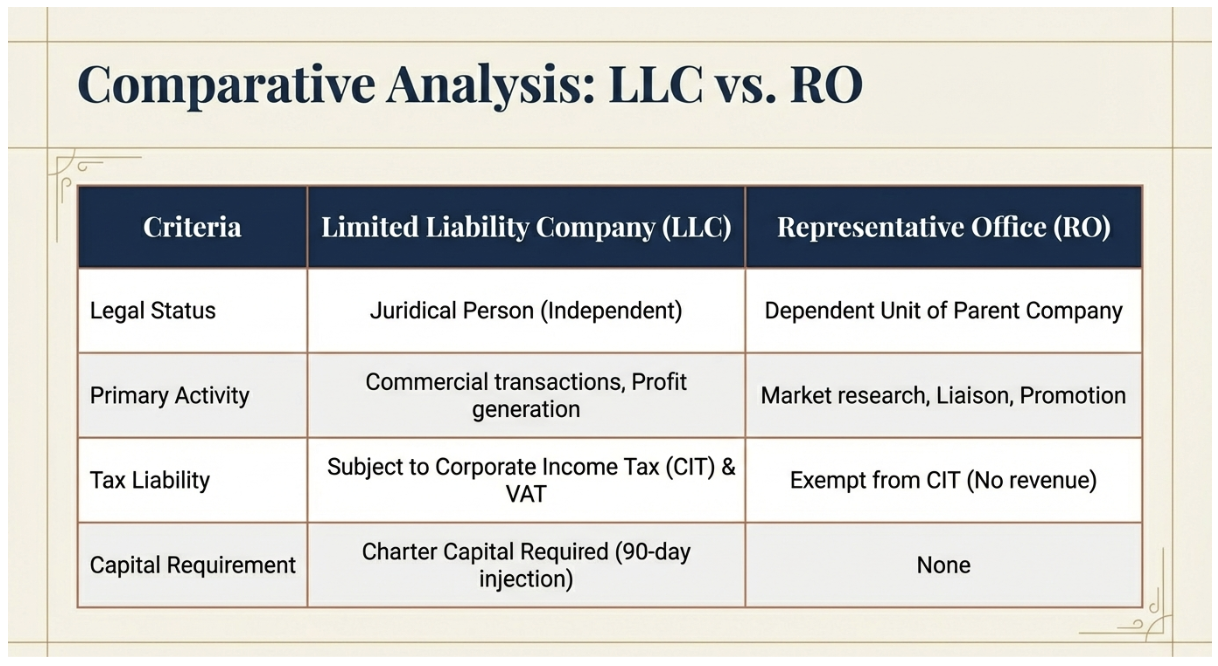
The fundamental distinction between these two entities lies in their legal status, scope of permitted activities, and tax liabilities.
Limited Liability Company (LLC)
An LLC constitutes a distinct legal entity (juridical person) established to conduct business for profit in Vietnam.
- Commercial Rights: An LLC possesses the full legal capacity to execute commercial transactions, issue VAT invoices, and generate revenue directly from clients.
- Charter Capital: Investors must subscribe to and fully contribute the registered “Charter Capital” within 90 days of issuance of the Enterprise Registration Certificate. generally, there is no statutory minimum capital unless prescribed for specific conditional sectors (e.g., banking, insurance, education).
- Compliance Burden: The establishment involves a rigorous licensing regime and ongoing statutory obligations regarding accounting, auditing, and tax reporting.
Representative Office (RO)
A representative office Vietnam is defined as a “dependent unit” of the foreign parent company, established solely to explore the market and facilitate trade.
- Restricted Scope: Its function is strictly limited to market research, liaison activities, and the promotion of investment opportunities for the parent company.
- Prohibition on Profit: An RO is legally prohibited from engaging in direct profit-generating activities. It cannot execute commercial contracts (unless authorized by the parent company for specific administrative tasks) nor receive funds directly from customers.
- Operational Advantages: The setup procedure is expedited, there are no capitalization requirements, and the tax reporting burden is significantly lower (exempt from Corporate Income Tax as there is no assessable revenue).
2. The Licensing Process: IRC & ERC
Establishing a foreign-owned LLC generally necessitates a bipartite licensing procedure, often referred to as the “Double License” system.
Step 1: Investment Registration Certificate (IRC)
Prior to entity formation, foreign investors must secure approval for their specific investment project.
- Legal Requirement: Mandatory for projects funded by foreign investors.
- Procedure: The investor submits a dossier detailing the project’s economic objectives, scale, and location to the competent investment registration agency (typically the Department of Planning and Investment (DPI) or the Management Board of Industrial Zones).
- Note: Under the Law on Investment 2025, certain M&A activities (capital contribution or share acquisition in existing entities) may be exempt from the IRC requirement, contingent upon ownership ratios and business lines.
Step 2: Enterprise Registration Certificate (ERC)
Upon issuance of the IRC, the investor proceeds to the Vietnam company registration phase.
- Legal Effect: The issuance of the Enterprise Registration Certificate (ERC) marks the official legal birth of the company and serves as its Tax Identification Number.
- Post-Licensing Timeline: Once the ERC is obtained, the company is legally operational. The investor is strictly obligated to inject the full charter capital within the statutory 90-day period.
3. Conditional Business Lines & Market Access
Vietnam maintains a “Negative List” approach to foreign investment. Under Article 8 of the Law on Investment 2025, the government promulgates a list of industries subject to market access conditions.

Restricted and Conditional Access
- Foreign Ownership Caps: Certain sectors may impose a ceiling on the percentage of foreign equity or mandate a Joint Venture structure with a local partner.
- Sub-Licenses: Even if market access is granted, specific industries classified as “Conditional Business Lines” (Appendix IV of the Law on Investment 2025 lists 198 such lines) require an additional operating license after the ERC is issued.
📞 Contact DHH Law Firm Today
Ready to Enter the Vietnam Market? Choosing between a Representative Office and an LLC impacts your tax liability and commercial capabilities for the lifespan of your investment.
🏢 Main Office: 2nd Floor, 829 Huynh Tan Phat Street, Phu Thuan Ward, Ho Chi Minh City, Vietnam
📞 Hotline:
- +84 89 9352 777 (Vietnamese)
- +84 89 9351 777 (English)
🌐 Website: www.dhhlawfirm.vn
📧 Email: contact@dhhlawfirm.vn
✨ DHH Law Firm – Your trusted legal partner for family and foreign-related civil procedures in Vietnam.