For expatriates residing in or departing from Vietnam, securing a Vietnam criminal record certificate (statutorily referred to as the Judicial Record Card is a mandatory prerequisite for various administrative procedures, including work permit applications, international adoption, or immigration filings for third countries.
However, the Vietnamese legal system bifurcates these records into two distinct classifications: Card No. 1 and Card No. 2. Selecting the incorrect classification can result in the immediate rejection of your application by foreign authorities. This guide elucidates the statutory distinctions and the procedural framework for obtaining your criminal record for foreigners in Vietnam, even post-departure.
1. Statutory Distinction: Judicial Record Card No. 1 vs. No. 2
The Law on Judicial Records differentiates these two instruments based on the requesting entity and the scope of disclosure regarding the individual’s criminal history.
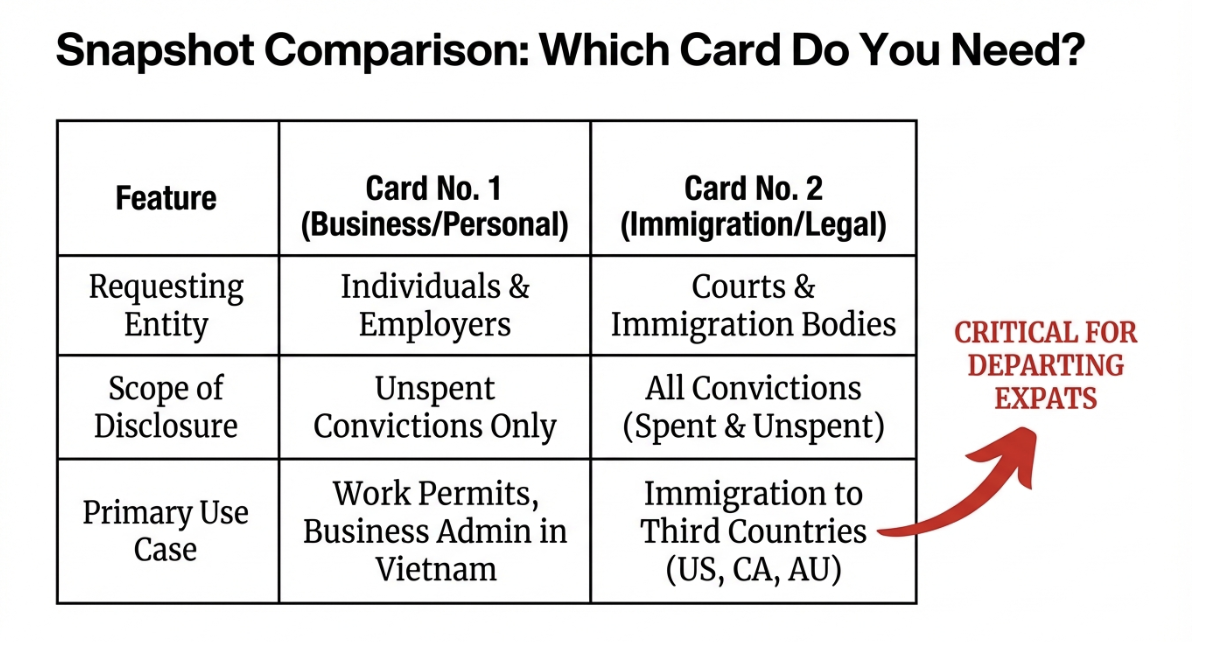
Judicial Record Card No. 1
- Eligible Applicants:
- Individuals (both foreign nationals and Vietnamese citizens) requesting the record for personal use.
- State agencies and organizations requiring the record for personnel management, business registration, or labor compliance (e.g., Work Permits).
- Scope of Disclosure:
- It records only unspent convictions (convictions that have not yet been legally expunged).
- Legal Benefit: If an individual has a prior conviction but has satisfied the statutory conditions for “expungement” (remission of criminal record), or has no criminal history, the card will explicitly state: “No criminal record”.
- Purpose: This card is designed to facilitate the social reintegration of former offenders by limiting the disclosure of cleared offenses.
Judicial Record Card No. 2
- Eligible Applicants:
- Procedural agencies (Police, Courts, Procuracies) for the purposes of investigation, prosecution, and adjudication.
- Individuals desiring full disclosure of their own judicial history.
- Crucial Note: Immigration authorities of strict jurisdictions (e.g., USA, Canada, Australia) typically mandate Card No. 2 as it provides an exhaustive history.
- Scope of Disclosure:
- It lists ALL convictions, regardless of their expungement status (i.e., both spent and unspent convictions).
- It provides a comprehensive chronological history, including dates and specific details of all past judgments.
2. Jurisdiction: Determining the Competent Authority
The venue for submission is legally determined by the applicant’s current residence status.
- Foreigners Currently Residing in Vietnam:
- Competent Authority: The Department of Justice in the province or municipality where the applicant holds temporary or permanent residence.
- Foreigners Who Have Departed Vietnam:
- Competent Authority: The National Center for Judicial Records, typically located in Hanoi.
3. Application Procedures for Non-Residents
A common procedural hurdle for expatriates arises after they have exited the Vietnamese territory. The procedure varies significantly based on the type of card required.
For Card No. 1: Authorization Permitted
If the objective is to obtain Card No. 1 (e.g., for re-employment in Vietnam), the law permits the applicant to authorize a third party (such as a legal representative, friend, or relative) to submit the dossier.
- Legal Requirement: The authorization must be executed via a written Power of Attorney, which must be notarized or certified in accordance with civil law.
- Exemption: If the authorized representative is a spouse, parent, or child of the applicant, a formal Power of Attorney is waived (proof of relationship is required).
For Card No. 2: Strict Personal Submission
Legal Warning: Pursuant to Article 46 of the Law on Judicial Records, individuals requesting Card No. 2 are legally prohibited from authorizing others to conduct the submission procedures.
- Procedural Implication: If you are abroad, you must submit the request personally via the postal service or designated online systems of the National Center for Judicial Records. Service providers cannot legally sign the application form on your behalf; their role is limited to logistical support and dossier preparation.
4. Documentary Requirements & Statutory Timeline
The Application Dossier
To ensure validity, the dossier must include:
- Request Form: The standard Declaration requesting the issuance of the Judicial Record Card (Form No. 03/2013/TT-LLTP).
- Passport Copy: A certified copy of the valid Passport (and visa/residence card/TRC if applicable during the stay in Vietnam).
- Residence Proof: Certified copies of documents proving temporary residence history in Vietnam.
Statutory Processing Time
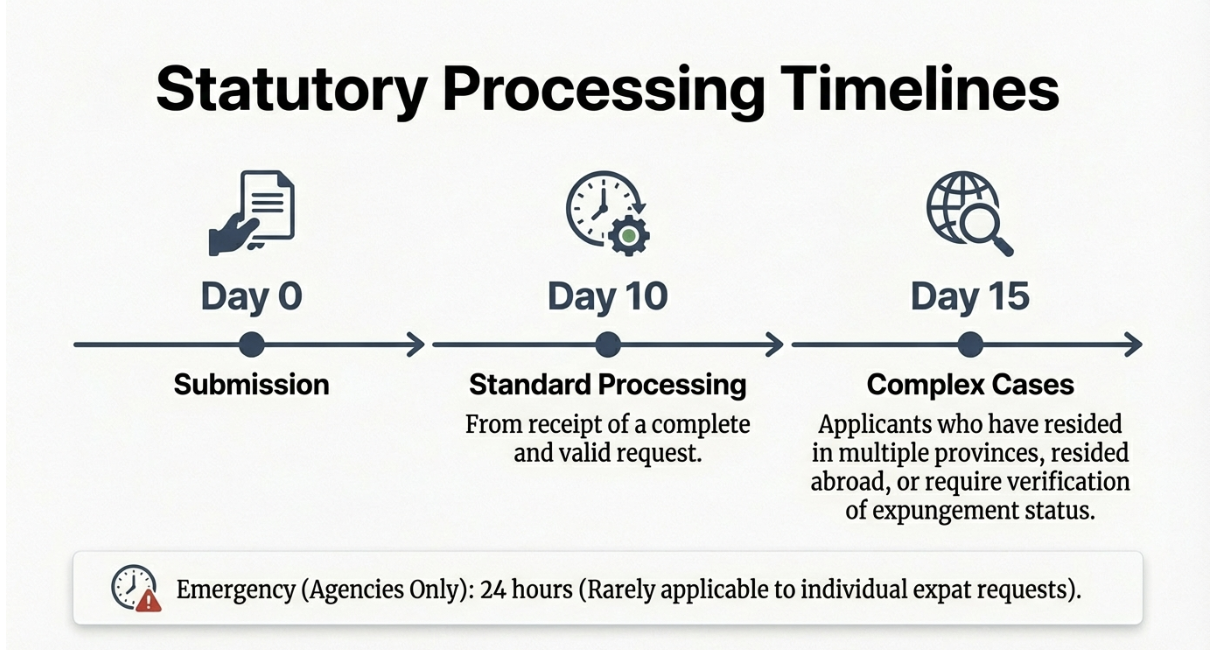
- Standard: Within 10 days from the receipt of a complete and valid request.
- Complex Cases: For applicants who have resided in multiple provinces or abroad, or requiring verification of expungement status, the timeline is extended to 15 days.
- Emergency (Agencies Only): Within 24 hours (rarely applicable to individual requests).
📞 Contact DHH Law Firm Today
Need Help Navigating the Bureaucracy?
- For Card No. 1: We can act as your authorized legal representative in Vietnam to handle the entire filing and retrieval process.
- For Card No. 2: Our team provides expert guidance through the complex postal submission process to the National Center to ensure your application is accurate and compliant, preventing rejection.
🏢 Main Office: 2nd Floor, 829 Huynh Tan Phat Street, Phu Thuan Ward, Ho Chi Minh City, Vietnam
📞 Hotline:
- +84 89 9352 777 (Vietnamese)
- +84 89 9351 777 (English)
🌐 Website: www.dhhlawfirm.vn
📧 Email: contact@dhhlawfirm.vn
✨ DHH Law Firm – Your trusted legal partner for family and foreign-related civil procedures in Vietnam