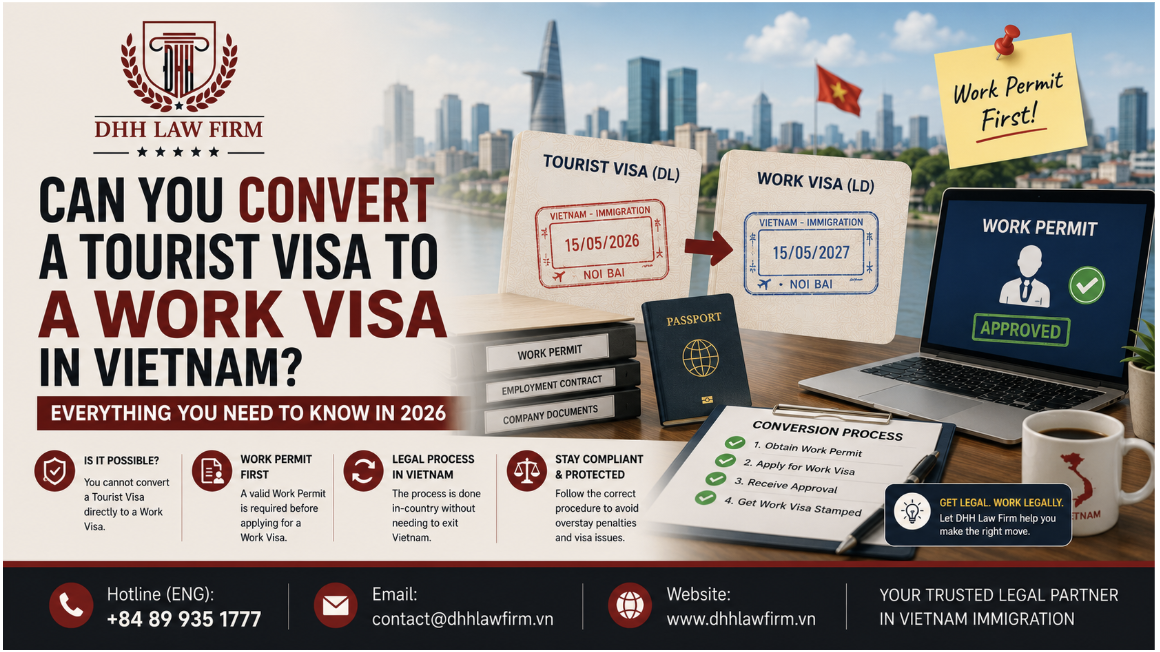
You Just Got a Job Offer… Now What Happens to Your Tourist Visa?
Imagine this. You came to Vietnam on a short visit. Perhaps your original plan was simply to travel, meet friends, explore business opportunities, or attend a few meetings. Then something unexpected happened. A Vietnamese company offered you a job. It is exactly the opportunity you were hoping for. Naturally, your next question is: “Can I convert my Tourist Visa to a Work Visa in Vietnam?”
You search online. One website says yes. Another says no. A Facebook group tells you to leave Vietnam immediately. Someone else insists that your employer can “change everything” without you doing anything. So, who is right?
The answer is more nuanced than a simple yes or no. Whether you can convert a Tourist Visa to a Work Visa in Vietnam depends on your current immigration status, your employer’s circumstances, the type of work you will perform, and whether you meet the legal requirements for foreign employment in Vietnam.
That is why two foreign professionals with almost identical job offers may receive completely different immigration advice. Before making any decisions, it is important to understand which situation most closely matches your own.
Which Situation Sounds Like You?
Instead of reading an entire legal article from beginning to end, start with the scenario that best reflects your current circumstances.
Scenario A
“I arrived in Vietnam as a tourist, and a company has just offered me a full-time position.”
You are excited about the opportunity but unsure whether your current visa allows you to begin working immediately.
➡ Continue with Section 1.
Scenario B
“My employer told me they will convert my Tourist Visa into a Work Visa.”
It sounds simple. But is the process really that straightforward?
➡ Continue with Section 2.
Scenario C
“Someone told me I must leave Vietnam before getting a Work Visa.”
You have heard conflicting advice and want to know whether leaving Vietnam is always necessary.
➡ Continue with Section 3.
Scenario D
“I’ve already started working while still holding my Tourist Visa.”
Now you are worried that your immigration status may not match your employment situation.
➡ Continue with Section 4.
Section 1 – “I Just Received a Job Offer.” What Should I Do First?
Receiving a job offer is exciting. Many foreign professionals immediately begin thinking about salary negotiations, relocation, or their first day at work. However, before accepting the position, there is another important question that deserves attention: Does your current immigration status allow you to take that job?
Foreign professional in Vietnam receiving a job offer while holding a passport
One of the biggest misconceptions is that receiving an employment offer automatically means you can start working. In reality, a job offer is only the beginning of a much larger legal process.
Before your employer can lawfully engage you, several immigration and employment requirements may need to be considered.That is why experienced employers often review immigration matters before discussing onboarding dates.
📊 Decision Timeline
Receive a Job Offer → Review Current Visa Status → Determine Whether a Work → Permit Is Required → Assess the Appropriate Immigration Pathway → Complete the Necessary Immigration Procedures → Begin Working Legally in Vietnam
This timeline illustrates an important principle: The employment offer comes first. The legal assessment comes immediately afterwards. Only then should the immigration process move forward.
💡 Legal Insight
Many foreign professionals believe the employment contract is the document that allows them to begin working. In practice, an employment contract and immigration compliance are separate legal matters. Accepting a job offer does not automatically change your immigration status or authorize employment in Vietnam.
Why Many Foreign Employees Contact DHH LAW FIRM at This Stage?
This is often the point where uncertainty begins. Some employers confidently tell new recruits: “Don’t worry—we’ll handle everything.” Others advise employees to leave Vietnam immediately. Meanwhile, different online sources offer completely different answers. Rather than relying on assumptions, DHH LAW FIRM recommends reviewing the facts of your individual case before taking any action. A short legal assessment at this stage can often identify the most suitable immigration pathway and prevent unnecessary delays later in the recruitment process.
Section 2 – “My Employer Says They Can Convert My Tourist Visa.” Is It Really That Simple?
For many foreign professionals, this conversation happens within the first few days after receiving a job offer.It usually sounds something like this.
HR manager discussing visa and employment documents with a foreign employee in Vietnam
Employer: “Congratulations! We’d like you to join our team.”
The excitement is understandable.Then comes the next question. “I entered Vietnam on a Tourist Visa. Is that a problem?”
The HR representative smiles. “Don’t worry. We’ll convert it into a Work Visa.”
At first, everything sounds straightforward. But this is often the moment when misunderstandings begin.
Reality Check: What Your Employer Means vs. What Immigration Law Requires
In practice, employers and employees sometimes use the phrase “convert a Tourist Visa into a Work Visa” as a convenient way of describing the immigration process.
From a legal perspective, however, the process is often more complex than simply replacing one visa with another. Rather than thinking about it as changing one sticker in your passport, it is more helpful to think of it as moving from one legal immigration purpose to another.
That transition may involve several separate legal procedures, each with its own requirements and timeline. This is why two employees hired on the same day by different companies may follow completely different immigration pathways.
Employer Says
“We’ll change your Tourist Visa after you sign the contract.”
Immigration Reality
Signing an employment contract is an important step, but it does not automatically change your immigration status. Employment documentation, labour compliance and immigration procedures are closely related, yet they remain legally independent processes.
Before any immigration status is changed, the authorities may need to consider factors such as the nature of the employment, the employer’s eligibility and the foreign employee’s current immigration circumstances.
Employer Says
“Once we apply for your Work Permit, everything is legal.”
Immigration Reality
A Vietnam Work Permit and a visa serve different legal purposes. A Work Permit generally relates to your legal authorization to perform work. A visa determines the legal basis for your stay in Vietnam. Although these procedures often progress together, one does not automatically replace the other.
This distinction is one of the most common misunderstandings encountered by the immigration lawyers at DHH LAW FIRM.
Employer Says
“You can start working while the paperwork is being processed.”
Immigration Reality
Many foreign employees mistakenly assume that because the company has already begun preparing documents, they may immediately start working. Whether this is appropriate depends on the individual’s immigration and employment status.
Starting work before all necessary legal requirements have been properly addressed can create avoidable complications for both the employee and the employer. For this reason, DHH LAW FIRM recommends reviewing the complete legal pathway before agreeing on a start date.
💡 Legal Insight
One of the biggest misconceptions is that a Work Permit automatically changes your visa. In reality, employment authorization and immigration status are separate legal matters. Understanding how these procedures interact is essential for avoiding future immigration issues.
The Better Question Isn’t “Can I Change My Visa?”
Many foreigners focus on a single question:
“Can I convert my Tourist Visa to a Work Visa in Vietnam?”
At DHH LAW FIRM, we usually ask a different question first.
“What is the correct immigration pathway for your situation?”
That slight change in perspective often leads to a much clearer understanding of the available options. Instead of treating every foreign employee the same, our immigration lawyers examine several aspects of the case together:
- your current immigration status;
- the type of employment you will undertake;
- your employer’s circumstances;
- whether a Vietnam Work Permit is required; and
- your long-term plans in Vietnam.
Only after reviewing the complete picture can the most appropriate immigration strategy be identified. This approach not only helps reduce legal uncertainty but also avoids unnecessary delays later in the employment process.
Immigration lawyer explaining visa and work permit procedures to a foreign employee
Case Study: Two Employees, Two Completely Different Outcomes
To understand why every case requires individual assessment, consider the following example.
Employee A: Emma entered Vietnam on a Tourist Visa to explore the country. After several weeks, she received a job offer from an international technology company. Before accepting the position, both Emma and her employer sought legal advice from DHH LAW FIRM. After reviewing her immigration status, employment plans and supporting documents, our legal team outlined the appropriate immigration pathway before she began working. As a result, the transition was carefully planned and unnecessary delays were avoided.
Employee B: Michael was also in Vietnam on a Tourist Visa. He received a similar job offer. Confident that “the company would handle everything,” he began working immediately without first reviewing his immigration position. Several weeks later, he realised that the immigration process involved additional legal considerations that neither he nor his employer had anticipated. Although the situation was ultimately resolved, it required considerably more time and planning than if the legal pathway had been assessed from the beginning.
📌 Practical Tip
Receiving a job offer should be the beginning of your employment journey—not the beginning of an immigration problem. Before resigning from your previous position, signing an employment contract or agreeing on a start date, make sure you understand how your employment plans align with your current immigration status. A short consultation at the outset can often prevent much more complicated issues later.
Section 3 – “Do I Need to Leave Vietnam Before Getting a Work Visa?”
This is probably one of the most debated questions among expats living in Vietnam. Ask five people, and you may receive five different answers. Some will confidently tell you: “Yes. Everyone has to leave Vietnam first.” Others will insist: “No. Everything can be done without leaving.”
The truth is that neither answer is always correct. Whether you need to leave Vietnam depends on your individual immigration pathway, not on what happened to someone else. Instead of searching for a universal answer, it is more helpful to identify where you currently are in the immigration process.
Immigration Decision Tree
Rather than asking:
“Do I need to leave Vietnam?”
Ask yourself these questions instead.
Are you currently in Vietnam?
│
▼
Do you already have a job offer?
│
Yes ───── No
│ │
▼ ▼
Has your employer reviewed
your immigration status?
│
Yes ───── No
│ │
▼ ▼
Has the appropriate
immigration pathway
been identified?
│
Yes ───── No
│ │
▼ ▼
Proceed with the
recommended procedure
or
Seek legal advice before
making travel arrangements.
Notice something important.
The decision tree never asks:
“Can I change my visa?”
Instead, it asks:
“Has the correct immigration pathway been identified?”
That small difference often determines whether the process goes smoothly or becomes unnecessarily complicated.
💡 Legal Insight
Many immigration delays occur not because a foreign employee lacks the required documents, but because decisions are made before the overall immigration strategy has been reviewed.
Planning first almost always saves time later.
There Is No “One-Size-Fits-All” Answer
Two foreign professionals may both receive job offers from Vietnamese companies on the same day.
Yet their immigration solutions can be completely different.
Why?
Because immigration authorities evaluate the individual circumstances, not simply the job title or visa category.
Factors that may influence the appropriate pathway include:
- the foreign national’s current immigration status;
- the purpose of the intended employment;
- the employer’s circumstances;
- previous immigration history; and
- other supporting legal documents.
This is precisely why DHH LAW FIRM never provides generic answers such as:
“Yes, you must leave Vietnam.”
or
“No, you never have to leave.”
Instead, our immigration lawyers begin by understanding the complete picture before recommending the most appropriate legal solution.
Section 4 – “I’m Already Working While Holding a Tourist Visa.” What Should I Do?
This is a situation many foreign employees are reluctant to discuss.
Sometimes, the employer says:
“Let’s begin working first. We’ll complete the paperwork later.”
Sometimes, the employee believes the immigration process will be completed quickly.
And sometimes, both parties simply misunderstand how immigration and employment regulations interact.
Whatever the reason, many people only begin asking questions after they have already started working.
At this stage, the most important thing is not to panic, but also not to ignore the situation.
Taking professional advice early is generally more effective than waiting until another immigration procedure—or an international trip—forces the issue to be addressed.
Foreign professional working in a modern office in Vietnam