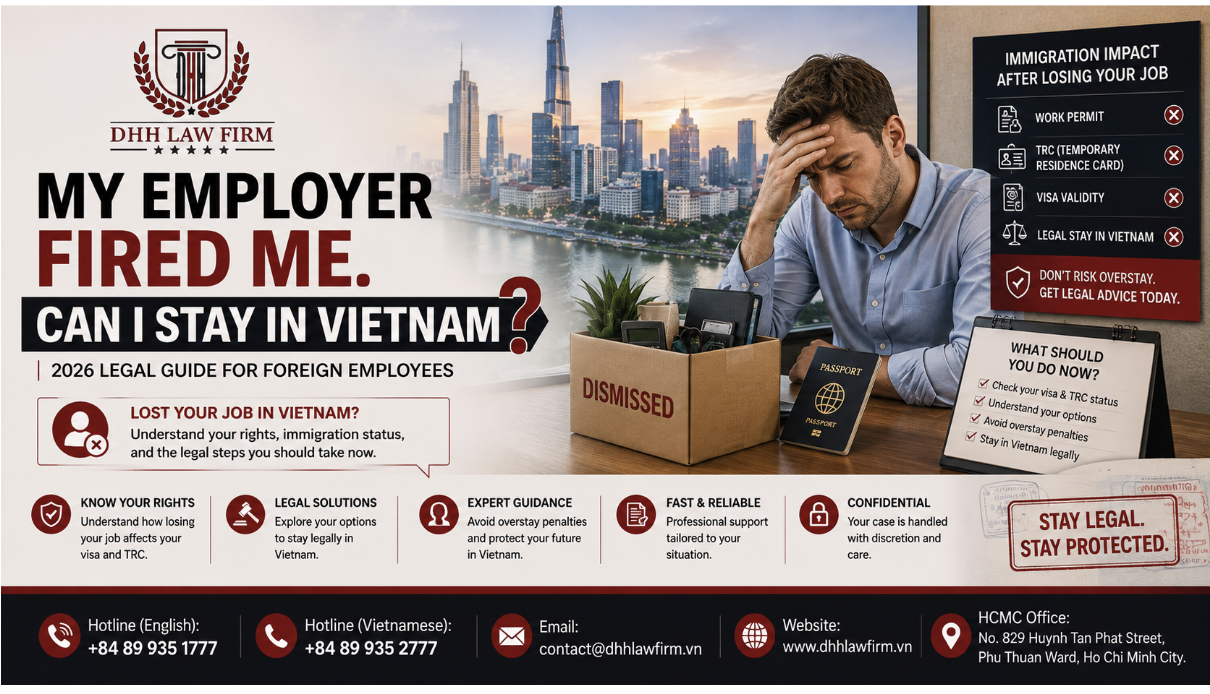
My Employer Fired Me. Can I Still Stay in Vietnam?
Losing a job is stressful enough. For a foreign employee in Vietnam, however, there is another question that often appears immediately after the employment relationship ends:
“What happens to my immigration status?”
You may still have months left on your visa. Your Temporary Residence Card (TRC) may show an expiry date far in the future. Your Work Permit may also appear to remain valid. So it is natural to think:
“I have legal documents. Surely I can stay until they expire.”
This is where things can become complicated. For foreign employees, employment status, sponsorship and immigration status can be closely connected. When your employment ends, you should review these documents rather than simply relying on the expiry date printed on them. The good news is that losing your job does not necessarily mean you must leave Vietnam immediately.
Depending on your circumstances, you may have options to change employer, adjust your immigration status, or make other lawful arrangements. The key is knowing what needs to be addressed before you continue staying or start working for someone else.
Quick Answer: Can You Stay in Vietnam After Losing Your Job?
Possibly, but you should not assume that your previous employment-based immigration status automatically continues unchanged.
Your situation should be reviewed based on:
Employment termination → Work Permit → Visa/TRC → Sponsor → New employer or departure plan
These elements are connected, but they are not the same thing. For example, having a visa that remains valid does not automatically mean you can work for a new employer. Similarly, holding a TRC does not necessarily mean that the circumstances supporting that residence status remain unchanged after your employment ends.
At DHH LAW FIRM, we recommend reviewing your immigration position as soon as your employment ends, particularly if you plan to remain in Vietnam and look for another job.
1. What Happens to Your Immigration Status When Employment Ends?
The first thing to understand is that employment termination and immigration termination are not necessarily the same event. Your employer may terminate your employment contract on a particular date. Your immigration documents may have different validity periods.
This creates one of the most common misunderstandings among foreign employees:
“My job ended, but my visa is still valid, so nothing has changed.”
That conclusion may be too simple. If your immigration status was based on your employment, sponsorship or relationship with your former employer, the end of that relationship may require additional immigration action.
This is why DHH LAW FIRM advises foreign employees not to look at their passport alone. A proper assessment should consider the entire immigration file and the legal basis under which the foreign national is staying in Vietnam.
💡 Legal Insight
The expiry date printed on an immigration document is not always the only factor that matters. The underlying purpose and sponsoring relationship may also be relevant when your employment situation changes.
If you have lost your job, review your status before assuming that you can simply continue living and working in Vietnam as before.
2. What Happens to Your Work Permit?
Your Work Permit is an important issue because it is connected to your employment in Vietnam. If your Work Permit was obtained for a particular employer, you should not assume that it automatically authorizes you to work for another company. This becomes particularly important when you receive a new job offer shortly after being dismissed.
You might think:
“I already have a Work Permit, so I can start working for the new company.”
That can be risky. A change of employer may require new or additional employment and immigration procedures, depending on the circumstances. The safest approach is to determine what is required before starting work for the new employer.
At DHH LAW FIRM, we regularly assist foreign employees during this transition—from ending employment with one company to establishing a lawful employment and immigration arrangement with another.
Foreign employee reviewing passport, Work Permit and Temporary Residence Card after losing a job in Vietnam
3. What Happens to Your TRC?
The situation requires even more attention if you hold a Temporary Residence Card (TRC). A TRC may have a relatively long validity period, which can lead foreign employees to believe that they can continue using it regardless of changes to their employment.
However, an employment-based residence arrangement may be connected to the sponsoring organization and the purpose for which the residence status was granted. Therefore, after losing your job, it is important to determine whether your existing TRC remains appropriate for your current circumstances, or whether further procedures are required. This is particularly important if you intend to remain in Vietnam while looking for a new employer.
4. Can You Stay While Looking for a New Job?
This is perhaps the most important practical question. The answer depends on your current immigration status and the legal basis for your continued stay.
There is no general rule that says:
“Once a foreign employee loses a job, they automatically have 30, 60 or 90 days to find another employer.”
Likewise, you should not assume that you must leave Vietnam immediately in every case. Your available options depend on your individual circumstances.
For example, your situation may be different if you:
- still hold a valid immigration status with an independent legal basis;
- have already found another eligible employer;
- have a family-based immigration status;
- hold an investor-related status; or
- need to resolve an existing immigration issue before making a new application.
5. What If You Already Found a New Employer?
Finding a new job quickly is obviously good news. But there is an important distinction between: “I have a new job offer.” and “I am legally ready to start working for my new employer.”
The second question requires a proper review. Your new employer may need to complete the applicable employment procedures, while your immigration status may also need to be updated depending on your circumstances.
6. When Could an Exit Visa Become Relevant?
Not every foreigner who loses a job needs an Exit Visa. However, an Exit Visa may become relevant in certain immigration situations where a foreign national needs to complete additional formalities before leaving Vietnam.
The possibility becomes particularly important if losing employment is accompanied by another immigration issue—for example, a change or cancellation of residence status, an expired visa, or another unresolved immigration matter. Therefore, if you decide not to seek a new employer and instead leave Vietnam, do not wait until the airport to discover whether additional procedures are necessary.
DHH LAW FIRM can review your immigration documents in advance and help determine what needs to be addressed before departure.
7. Stay, Change Employer or Leave Vietnam?
If you have lost your job, there are generally three practical directions to consider.
| Your situation | What to consider |
| You want to stay and find another job | Review whether your current immigration status provides a lawful basis to remain and what must be done for new employment. |
| You already have a new employer | Review the Work Permit and immigration requirements before starting work. |
| You plan to leave Vietnam | Check whether your visa, TRC or other immigration circumstances require additional procedures before departure. |
There is no universally correct option. The right path depends on your documents, employment history and immigration status.
8. Common Mistakes After Losing a Job
The biggest problems often occur when foreigners assume that employment and immigration are automatically disconnected.
Mistake 1: Continuing to work for the new employer immediately: Having a new job offer does not necessarily mean you can start working immediately.
Mistake 2: Assuming your old Work Permit transfers automatically: A Work Permit connected to one employment relationship should not simply be treated as a general authorization to work for any company.
Mistake 3: Ignoring your TRC: A TRC with a future expiry date should not automatically be assumed to remain unaffected after the underlying employment relationship changes.
Mistake 4: Relying on a “30-day rule” found online: Immigration circumstances differ. There is no reason to assume that another foreigner’s timeline automatically applies to you.
Mistake 5: Waiting until your visa expires: Losing a job is already a major change. Allowing your immigration status to become problematic at the same time can make the situation significantly harder to resolve.
How DHH LAW FIRM Can Help
Losing a job as a foreigner in Vietnam often creates several questions at the same time:
Can I stay? Can I find another employer? What happens to my Work Permit? Is my TRC still valid? Do I need to leave Vietnam?
At DHH LAW FIRM, we approach these questions as one immigration case rather than treating each document separately. Our legal team can review your current visa or TRC, employment history, Work Permit and plans for your next employer. Based on that assessment, DHH LAW FIRM can advise on the appropriate immigration pathway and the procedures that may be required.
For foreign employees who have already found a new employer, DHH LAW FIRM can also help coordinate the transition so that employment and immigration procedures are properly aligned. If leaving Vietnam is the better option, DHH LAW FIRM can review the applicable departure requirements and assist with immigration procedures where necessary.
The objective is not simply to “keep you in Vietnam.”
The objective is to help you identify a lawful and practical immigration solution for your particular situation.
What Should You Do Today?
If your employment has just ended, avoid making your next decision based solely on the expiry date of your passport, visa or TRC.
Instead, take a moment to review four things:
When did your employment end?
What immigration document are you currently holding?
Who is currently sponsoring your immigration status?
Do you want to find a new employer or leave Vietnam?
Once these questions are clear, the appropriate next step becomes much easier to identify. If you are uncertain, contacting DHH LAW FIRM for an immigration assessment before starting a new job or making travel arrangements can help you avoid unnecessary complications.
Conclusion
Losing your job does not automatically mean that you must leave Vietnam immediately. At the same time, you should not assume that your previous Work Permit, visa or Temporary Residence Card (TRC) continues to operate exactly as before simply because the documents have not reached their printed expiry dates.
The right solution depends on your individual circumstances. You may be able to transition to a new employer, adjust your immigration arrangements, or prepare for an orderly departure from Vietnam.
What matters most is taking action before your immigration status becomes a second problem on top of losing your job. If you have recently lost your job in Vietnam and are unsure what happens next, DHH LAW FIRM can review your immigration circumstances and help you determine the most appropriate legal pathway.
Frequently Asked Questions
-
Can I stay in Vietnam after losing my job?
→ Possibly. Your ability to remain in Vietnam depends on your current immigration status and the legal basis for your continued stay. Losing employment does not create a universal automatic grace period for every foreign employee.
-
Can I use my old Work Permit for a new employer?
→ You should not assume that you can. A Work Permit connected to your previous employment may not automatically authorize you to work for a new company.
-
What happens to my TRC after I lose my job?
→ It depends on the basis on which your TRC was issued and your new circumstances. You should review your TRC and sponsorship status rather than relying only on its printed expiry date.
-
Do I need an Exit Visa after losing my job?
→ Not necessarily. Whether additional departure procedures are required depends on your specific immigration status and circumstances.
-
Can I look for another job while staying in Vietnam?
→ This depends on your current legal immigration status. You should establish that you have a lawful basis to remain in Vietnam before assuming that you can stay indefinitely while searching for employment.
Contact DHH Law Firm for Expert Immigration Support
- Hotline (English): +84 89 935 1777
- Hotline (Vietnamese): +84 89 935 2777
- Email: contact@dhhlawfirm.vn
- Website: www.dhhlawfirm.vn
- HCMC Office: No. 829 Huynh Tan Phat Street, Phu Thuan Ward, Ho Chi Minh City.