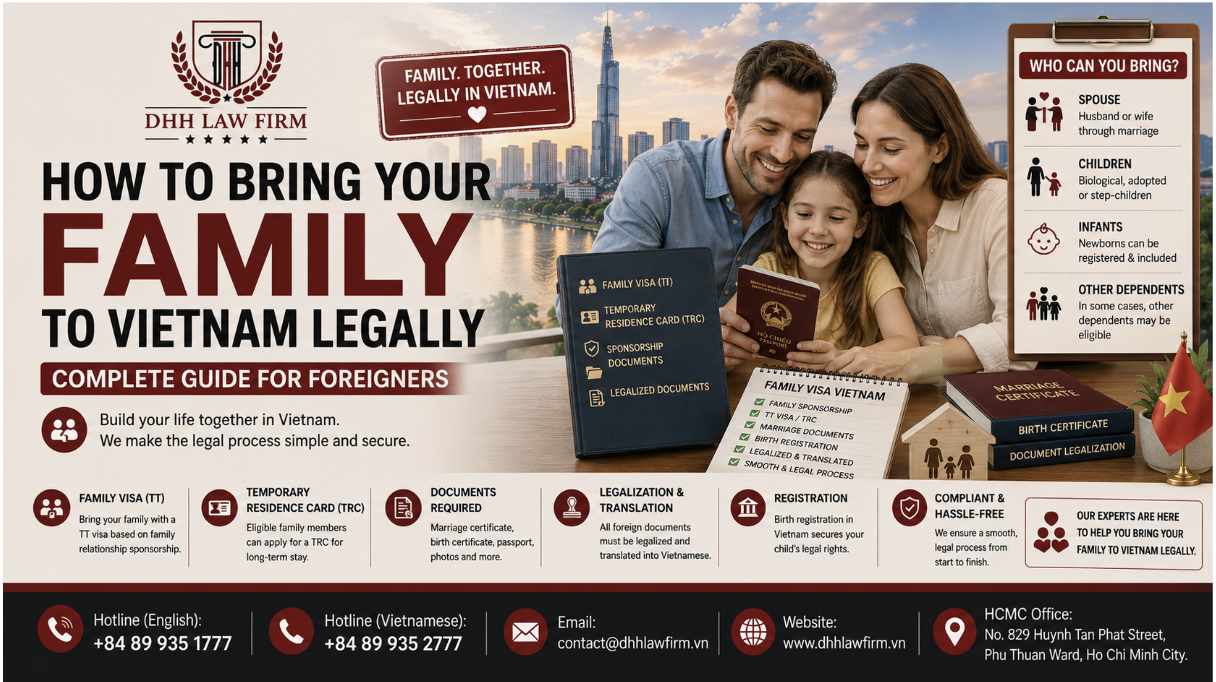
Bringing Your Family to Vietnam: Where Should You Start?
Moving to Vietnam for work, investment or business often begins with one person.
- A foreign professional accepts a job.
- An investor establishes a company.
- An expert relocates to Ho Chi Minh City or Hanoi.
Then comes the next question:
“Can I bring my wife and children to Vietnam with me?”
The answer is often yes, but the correct immigration route depends on the family’s circumstances. A spouse of a foreign worker may have a different immigration pathway from the spouse of an investor. A child born in Vietnam may require a different set of civil-status documents from a child who was born overseas.
This is why Family Visa Vietnam should not be treated as a single application. It is better understood as a family immigration process involving sponsorship, visas, residence status and, in some cases, civil-status documentation.
At DHH LAW FIRM, we help foreign employees, investors, business owners and their families understand how these different pieces fit together before they begin the application process.
Quick Answer: Can You Bring Your Family to Vietnam?
Yes, eligible foreign nationals may be able to sponsor or arrange immigration status for qualifying family members, depending on their own status in Vietnam and the relationship with the family member.
Vietnamese immigration law recognizes family-related visa and residence categories, including the TT visa category for certain family members. The law also provides mechanisms for eligible sponsors to invite or guarantee family members in Vietnam.
However, there is no universal “family visa” that applies identically to every family. The appropriate solution depends on questions such as:
- Who is the sponsor?
- Is the family member a spouse, parent or child?
- Is the sponsor an employee, investor or another qualifying foreign resident?
- Are the relationship documents issued in Vietnam or overseas?
- Does the family member need a visa, temporary residence card or another immigration arrangement?
These questions should be answered before preparing the application.
1. First, Identify the Family Relationship
The starting point is not the visa application. It is the relationship between the sponsor and the family member.
For many families, this means:
- husband or wife;
- children;
- parents; or
- other family relationships recognized under the applicable immigration rules.
The relationship must generally be supported by appropriate official documents. For a spouse, this could mean a marriage certificate.
For a child, it could involve a birth certificate or other documentation establishing the parent-child relationship. This becomes particularly important when the document was issued outside Vietnam.
2. Family Sponsorship: Who Can Bring Family Members to Vietnam?
This is where the process becomes more specific. A foreign national who is legally residing in Vietnam may, depending on their immigration status and applicable regulations, have the ability to sponsor or arrange for certain family members to enter or reside in Vietnam.
The exact legal basis matters. For example, a foreign employee, an investor and a person holding another form of lawful residence may not have identical sponsorship arrangements.
The Vietnamese immigration framework expressly addresses situations in which eligible persons may invite or guarantee family members, including spouses and children, subject to the relevant conditions. Once that is established, it becomes much easier to determine what route is available for the family.
3. What Is the TT Visa Vietnam?
If you have searched for Family Visa Vietnam, you have probably encountered another term: TT Visa.
The TT visa is a family-related visa category under Vietnam’s immigration framework. It may apply to certain family members of eligible foreign nationals or Vietnamese citizens, depending on the specific legal relationship and circumstances. The current immigration law provides for the TT category within Vietnam’s visa classification system.
However, “TT visa” should not be treated as synonymous with every type of family immigration.
The correct eligibility depends on who the family member is related to and what immigration status the sponsor holds.
That distinction is important because choosing the wrong category at the beginning can create unnecessary document preparation and delays.
💡 Legal Insight
Family Visa Vietnam is a useful search term, but it is not necessarily the name of one single legal document. In practice, the correct immigration solution may involve a specific visa category, temporary residence card or another procedure depending on the sponsor and family member.
4. What About a TRC for Spouse?
For families planning to live in Vietnam long term, a visa may not always be the end goal. The more important question may be:
“Can my spouse obtain a Temporary Residence Card?”
In eligible circumstances, family members may qualify for residence arrangements connected to their relationship with the sponsor. A Temporary Residence Card (TRC) can be particularly relevant for families who expect to remain in Vietnam for an extended period rather than simply visiting for a few months.
However, eligibility and the appropriate TRC category depend on the underlying immigration status and relationship. This is one area where DHH LAW FIRM often recommends planning beyond the initial visa application.
Instead of asking only:
“How do I bring my spouse to Vietnam?”
consider:
“What immigration status will my spouse need for the next one, two or several years?”
That question can change the entire strategy.
A Simple Family Immigration Roadmap
The exact procedure can vary depending on the family, but this roadmap shows the basic logic.
5. What If Your Marriage Certificate Was Issued Overseas?
This is one of the biggest practical issues for international couples. Imagine that you married in the United States, France, Australia, Germany or another country.
You have a perfectly valid marriage certificate. But when you try to use that document for a Vietnamese immigration procedure, you may discover that additional document formalities are required.
This is where consular legalization and Vietnamese translation can become important. A foreign-issued public document may need to complete the applicable authentication or legalization process before it can be used in Vietnam, unless an exemption applies.
The exact requirements depend on the document, country of issuance and applicable legal basis. For this reason, couples should not wait until the visa application is ready before checking their marriage documents.
DHH LAW FIRM can review the document chain first and determine whether legalization, translation or other formalities need to be completed.
6. Bringing Children to Vietnam Is a Little Different
Children may require additional consideration because immigration is not the only issue involved. Depending on where the child was born and the parents’ circumstances, the family may need to consider:
Birth registration
Nationality
Passport
Parent-child relationship documentation
Visa or residence status
For a child born overseas, parents may need to provide a foreign birth certificate and other supporting documents. For a child born in Vietnam to foreign parents or to a foreign and Vietnamese parent, the family may also need to address Vietnamese civil-status and nationality issues.
This is why child residence in Vietnam should be planned together with birth and nationality documentation rather than treated as a simple visa application.
7. What If the Child Was Born in Vietnam?
This is where family immigration and civil-status law overlap. A child born in Vietnam may need to have the birth properly registered before parents can complete certain subsequent procedures.
If one parent is Vietnamese and the other is a foreign national, nationality and civil-status considerations can become particularly important. The family may also need to coordinate the child’s Vietnamese birth registration with the foreign parent’s embassy or consulate for nationality or passport purposes.
For families in this situation, DHH LAW FIRM can assist with coordinating the immigration and civil-status aspects rather than treating each document as an unrelated procedure.
8. What Documents Should You Prepare?
The exact list depends on the immigration category and the family relationship. However, applicants should generally expect to provide documents that establish three things:
Identity – The passports and relevant identification documents of the sponsor and family member.
Relationship – For example, a marriage certificate or birth certificate.
Immigration Basis – Documents showing the sponsor’s lawful immigration status and the basis on which the family member is applying.
Foreign-issued documents may also require additional formalities such as legalization and Vietnamese translation, depending on the specific procedure. The most important point is to check the document requirements before booking flights or making relocation arrangements.
Family Immigration: What Changes Depending on Your Situation?
| Family Situation | Key Issue to Review |
| Foreign employee bringing spouse | Sponsor’s immigration status + marriage documents |
| Foreign employee bringing children | Parent-child relationship + child’s passport/status |
| Foreign investor bringing family | Investor’s immigration status + qualifying relationship |
| Foreign spouse of Vietnamese citizen | Marriage registration/recognition + family-based immigration |
| Child born in Vietnam | Birth registration + nationality + passport + residence |
| Marriage certificate issued overseas | Legalization and Vietnamese translation may need to be reviewed |
This is why a “family visa checklist” found online may not be enough. The correct documents depend on your family structure and the sponsor’s status.
9. The Most Common Mistakes Families Make
Mistake 1 — Applying for the Visa Before Checking the Relationship Documents
A family may spend weeks preparing an immigration application only to discover that their foreign marriage certificate has not been properly legalized.
Mistake 2 — Assuming Every Family Member Gets the Same Immigration Status
A spouse and child may have different documentation requirements. The sponsor’s immigration category also matters.
Mistake 3 — Waiting Until the Family Has Already Arrived
Immigration planning should ideally happen before relocation. Discovering that a document is missing after your spouse and children have already arrived can create unnecessary pressure.
Mistake 4 — Treating Birth Registration and Immigration as Separate Problems
For children born in Vietnam, birth registration, nationality, passport and residence may be interconnected. Planning them together is usually more efficient.
10. How DHH LAW FIRM Helps International Families
Bringing a family to Vietnam involves more than submitting a visa application. At DHH LAW FIRM, we begin by understanding the family’s structure and the sponsor’s current immigration status.
From there, our legal team can help determine the appropriate route for the spouse or children, review relationship documents, identify legalization or translation requirements, and coordinate the relevant immigration procedures.
For families with overseas marriage certificates, DHH LAW FIRM can also help review whether the documents are ready for use in Vietnam.
For children, the legal team can coordinate issues involving birth registration, nationality-related documents, passports and residence status, where these matters overlap with the family’s immigration plans.
For investors and foreign professionals relocating with their families, DHH LAW FIRM can help plan the family’s immigration arrangements alongside the sponsor’s own visa or TRC strategy.
The objective is simple:
Your family should not have to navigate several disconnected immigration procedures without understanding how they fit together.
Before Your Family Moves to Vietnam
If you are planning to bring your spouse or children to Vietnam, it is worth answering these questions before making travel arrangements:
What is your current immigration status?
Who are you sponsoring?
What documents prove your family relationship?
Were those documents issued in Vietnam or overseas?
Will the family need a visa, TRC or another immigration arrangement?
Will your children also require birth registration, nationality or passport procedures?
Once these questions are answered, the process becomes much clearer.
Conclusion: Plan the Family, Not Just the Visa
Moving to Vietnam as a family is fundamentally different from moving alone. Your immigration strategy needs to consider not only your own status but also the legal position of your spouse and children.
For some families, the immediate solution may be a TT Visa. For others, the longer-term goal may be a Temporary Residence Card.
Families with overseas marriage certificates may first need to resolve consular legalization. Families with children born in Vietnam may need to coordinate birth registration, nationality and passport procedures.
There is therefore no single “Family Visa Vietnam” solution that fits every family.
At DHH LAW FIRM, we help foreign employees, investors, spouses and international families identify the appropriate legal pathway before they begin the relocation process. If you are planning to bring your family to Vietnam, DHH LAW FIRM can review your circumstances, identify the documents and procedures involved, and help your family build a clear immigration plan from the beginning.
Frequently Asked Questions
-
What is a Family Visa in Vietnam?
→ “Family Visa” is commonly used to describe immigration arrangements that allow eligible family members to enter or reside in Vietnam based on a qualifying family relationship. The specific visa category and requirements depend on the sponsor and family member.
-
What is a TT Visa in Vietnam?
→ The TT visa is a family-related visa category under Vietnam’s immigration framework. Eligibility depends on the qualifying relationship and the immigration status of the relevant sponsor.
-
Can my spouse get a TRC in Vietnam?
→ In eligible circumstances, a foreign spouse may qualify for a Temporary Residence Card based on the applicable family relationship and immigration status. The exact category and requirements should be assessed individually.
-
Do I need to legalize a foreign marriage certificate?
→ A foreign-issued marriage certificate may require consular legalization and Vietnamese translation before it can be used for certain procedures in Vietnam, unless an applicable exemption exists.
4. Can I bring my children to Vietnam?
→ Eligible children may be able to obtain an appropriate visa or residence status, depending on their relationship to the sponsor and the sponsor’s immigration status.
-
What if my child was born in Vietnam?
→ The family may need to address birth registration, nationality, passport and immigration status. The appropriate sequence depends on the child’s parents and nationality circumstances.
Contact DHH Law Firm for Expert Immigration Support
- Hotline (English): +84 89 935 1777
- Hotline (Vietnamese): +84 89 935 2777
- Email: contact@dhhlawfirm.vn
- Website: www.dhhlawfirm.vn
- HCMC Office: No. 829 Huynh Tan Phat Street, Phu Thuan Ward, Ho Chi Minh City.