1. What is property division upon divorce involving foreigners?
Property division upon divorce involving foreigners is the legal process of identifying and partitioning ownership and usage rights of joint assets formed during a marriage between a Vietnamese citizen and a foreign national, or between two foreigners residing in Vietnam.
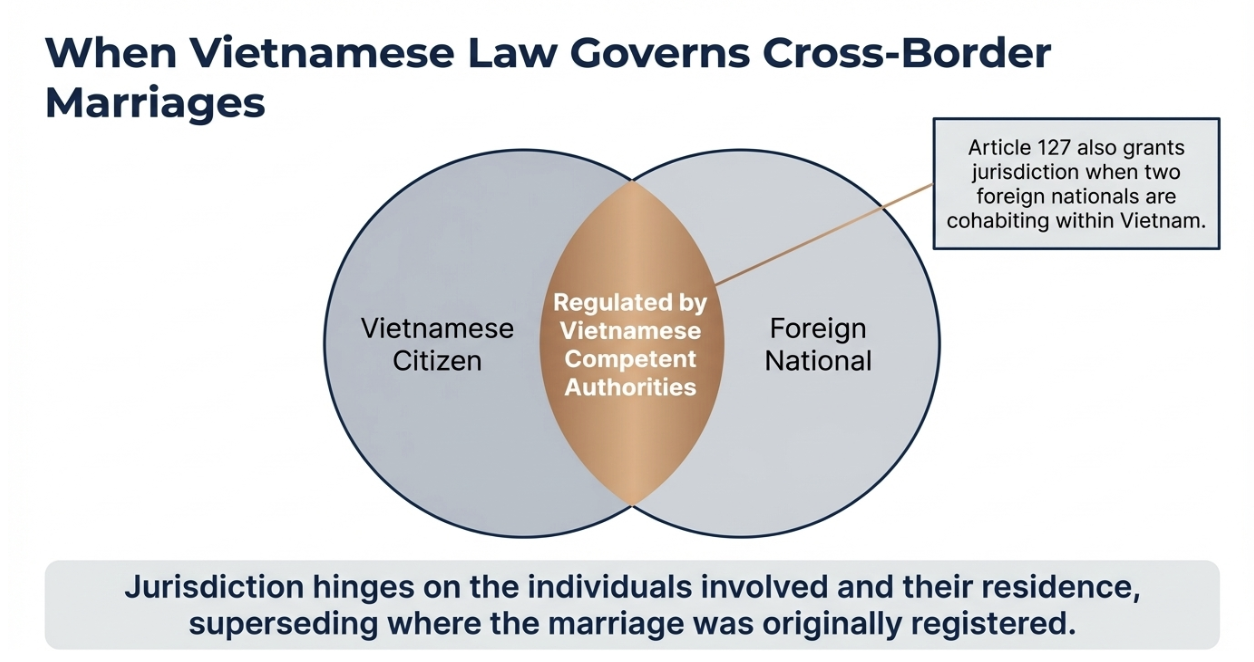
Pursuant to Article 127 of the Law on Marriage and Family 2014, divorce cases involving foreign elements (including property division) shall be resolved by Vietnamese competent authorities if one party is a Vietnamese citizen or both parties are foreigners cohabiting in Vietnam. In cases where the assets are real estate located abroad, the division must comply with the laws of the country where such real estate is situated.
2. Principles of property division upon divorce involving foreigners
According to Article 59 of the Law on Marriage and Family 2014, property division upon divorce involving foreigners is executed based on the following core principles:
- Priority of Mutual Agreement: The Court consistently prioritizes voluntary agreements between the parties regarding asset division. If the agreement does not violate social ethics or legal prohibitions, the Court will recognize such voluntary settlement.
- 50/50 Split with Practical Considerations: In the absence of an agreement, joint assets are generally divided equally, but with due consideration of:
- The circumstances of the family and of the husband and wife.
- The substantive contribution of each spouse to the creation, maintenance, and development of the common property.
- The protection of the legitimate interests of each party in production and business activities to ensure conditions for continued labor and income generation.
- The fault of each party in violating the rights and obligations of husband and wife.
- Separate Property Retention: Separate property remains the sole property of its respective owner unless it has been merged into the common property by the parties’ mutual intent.
Special Note on Real Estate: Under Article 469 of the Civil Procedure Code 2015, Vietnamese Courts hold exclusive jurisdiction over divorce cases involving disputes over real property (real estate) located within the territory of Vietnam.
3. Procedure for property division upon divorce involving foreigners at DHH Law Firm
At DHH Law Firm, we execute the procedure for property division upon divorce involving foreigners through a standardized legal process:
- Step 1: Asset Identification and Classification Attorneys assist in verifying the legal status of various assets (real estate, bank accounts, corporate shares, etc.). We clearly distinguish between separate property (gifts, individual inheritances) and joint property acquired during the marriage.
- Step 2: Preparation of the Petition or Request Dossier The dossier includes:
- Petition for asset division (or a request for recognition of consensual divorce including an asset division plan).
- Marriage Certificate (consularly legalized if the marriage was registered abroad).
- Documents proving asset ownership (Land Use Right Certificates, savings books, vehicle registrations, etc.).
- Passports/ID cards of both parties.
- Step 3: Resolution at Competent Courts
- Jurisdiction: The Provincial-level People’s Court where either party resides or where the real estate is located.
- Timeline: Cases involving foreign elements typically last from 04 to 06 months (or longer if judicial entrustment abroad is required for testimony or asset verification).
- Outcome: A court judgment or decision that serves as the legal basis for the parties to perform procedures for title transfer and asset relocation.
CONTACT DHH LAW FIRM
🏢 Head Office: 2nd Floor, No. 829 Huynh Tan Phat Street, Phu Thuan Ward, District 7, Ho Chi Minh City, Vietnam.
📞 Hotline:
+84 89 9352 777 (VN)
+84 89 9351 777 (EN)
🌐 Website: www.dhhlawfirm.vn
📧 Email: contact@dhhlawfirm.vn