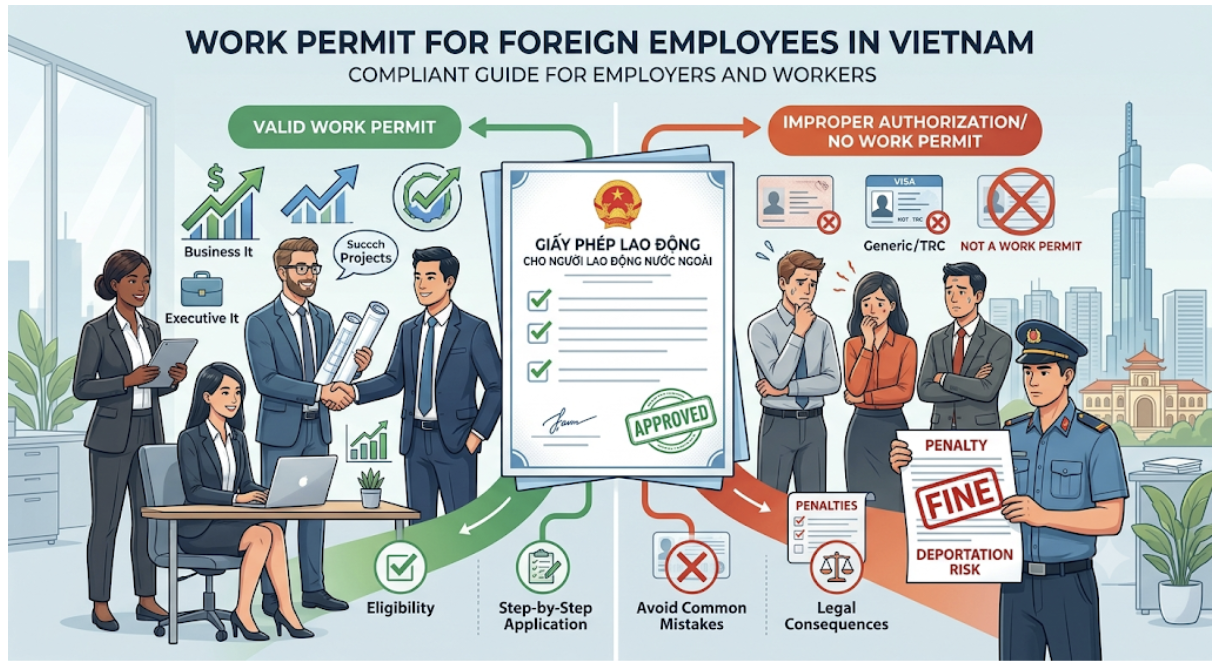
Vietnam continues to attract foreign professionals, executives, technical experts, and investors seeking opportunities in one of Asia’s fastest-growing economies. While hiring foreign talent can provide substantial benefits to businesses, employing a foreign national without proper authorization can expose both the employer and employee to serious legal consequences.
Understanding Vietnam’s work permit regulations is therefore essential for maintaining legal compliance and avoiding costly penalties. This guide explains who needs a work permit, eligibility requirements, application procedures, exemptions, and common compliance mistakes that employers should avoid.
Why Is a Work Permit Important in Vietnam?
A work permit serves as official authorization allowing a foreign national to work legally in Vietnam. For foreign-invested companies, work permit compliance is often reviewed during labor inspections and regulatory audits.
Who Needs a Work Permit in Vietnam?
As a general rule, foreign nationals working in Vietnam must obtain a work permit unless they qualify for a statutory exemption. Common categories requiring work permits include:
Who Is Exempt from Work Permit Requirements?
Not every foreign national working in Vietnam must obtain a work permit. Certain categories may qualify for exemptions under Vietnamese law.
Common examples include:
- Capital-contributing investors meeting statutory thresholds
- Owners of limited liability companies
- Members of boards of directors in certain cases
- Internal transferees within qualifying multinational corporations
- Foreign lawyers licensed to practice in Vietnam
- Individuals entering Vietnam for short-term assignments under specific conditions
Although exempt from obtaining a work permit, many individuals must still complete a work permit exemption registration procedure. Failure to register an exemption may still result in compliance issues.
Conditions for Obtaining a Work Permit
Foreign employees must satisfy several legal requirements before a work permit can be issued.
The Work Permit Application Process
Many employers underestimate the complexity of Vietnam’s work permit procedures. The process typically involves multiple stages.
How Long Does It Take to Obtain a Work Permit?
Processing timelines vary depending on:
- Country where documents are issued
- Consular legalization requirements
- Completeness of documentation
- Government processing workload
In practice, obtaining overseas documents often takes longer than the government review itself. Companies planning to recruit foreign employees should begin preparations several weeks in advance. Delays in document collection frequently impact onboarding schedules.
Common Challenges Faced by Foreign Employees
Degree and Experience Mismatch
Authorities carefully review whether educational qualifications and professional experience align with the proposed position. A mismatch may result in requests for additional explanations or rejection.
Incorrectly Legalized Documents
Foreign-issued documents must typically undergo legalization procedures before acceptance in Vietnam. Improper legalization remains one of the most common causes of delays.
Expired Supporting Documents
Criminal records and health certificates often have limited validity periods. Expired documents may require the application process to restart.
Incomplete Employment Verification
Many applicants struggle to obtain employment confirmation letters that satisfy Vietnamese regulatory requirements.
Risks of Working Without a Valid Work Permit
Some employers allow foreign personnel to begin working before obtaining proper authorization. This approach creates significant legal risks. Potential consequences include:
Administrative Penalties: Authorities may impose fines on employers and foreign employees.
Deportation Risks: Foreign nationals working illegally may face immigration enforcement measures.
Business Disruption: Regulatory investigations can interrupt business operations and delay projects.
Reputational Damage: Non-compliance may negatively affect future licensing applications and regulatory relationships. For foreign-invested enterprises, labor compliance is increasingly scrutinized by authorities.
Work Permit Renewal and Ongoing Compliance
Obtaining a work permit is only the first step. Employers must continuously monitor:
- Expiration dates
- Changes in job positions
- Changes in employer entities
- Updates to labor regulations
- Temporary residence card requirements
Failure to renew permits on time can create unexpected interruptions to employment arrangements. A proactive compliance strategy helps ensure uninterrupted operations.
Relationship Between Work Permits and Temporary Residence Cards
Many foreign employees require both a work permit and a Temporary Residence Card (TRC). These documents serve different legal purposes.
Work Permit: Authorizes employment.
Temporary Residence Card: Authorizes long-term residence in Vietnam. A valid work permit often serves as the foundation for obtaining a Temporary Residence Card. Businesses should coordinate both procedures to ensure full immigration compliance.
Example Scenario
A technology company hires a foreign software engineer and allows him to begin working immediately after entering Vietnam on a business visa. Several months later, during a labor inspection, authorities discover that the employee never obtained a work permit. The company faces administrative penalties, and the employee’s immigration status becomes subject to review. The issue could have been avoided through proper planning before the employee’s arrival. This situation is more common than many businesses realize.
Why Professional Legal Support Matters?
Work permit applications involve labor law, immigration regulations, document legalization requirements, and administrative procedures. Professional legal support can help employers:
- Determine eligibility before recruitment
- Assess work permit exemption possibilities
- Prepare compliant documentation
- Coordinate legalization and translation procedures
- Avoid costly delays and rejections
- Maintain ongoing labor compliance
For multinational companies and FDI enterprises, professional assistance often reduces both administrative burden and regulatory risk.
Frequently Asked Questions
Can a foreigner work in Vietnam with only a business visa?
→ Generally, no. A business visa does not automatically authorize employment.
How long is a work permit valid?
→ Validity depends on applicable regulations and supporting documentation, subject to statutory limitations.
Can a work permit be renewed?
→ Yes, provided the relevant legal requirements continue to be satisfied.
Does every foreign employee need a work permit?
→ No. Some individuals qualify for exemptions, although registration requirements may still apply.
Conclusion
Hiring foreign employees in Vietnam can provide significant strategic advantages, but it also creates important compliance obligations. Employers must ensure that foreign personnel possess the appropriate legal authorization before commencing work. Failure to comply may result in penalties, operational disruption, and immigration-related complications. By understanding the work permit process and addressing compliance requirements early, businesses can reduce risk and support a smooth employment experience for foreign talent.
Need Assistance with Work Permit Applications in Vietnam?
DHH LAW FIRM provides comprehensive support for work permits, work permit exemptions, temporary residence cards, investor visas, labor compliance reviews, and immigration-related services for foreign employees and FDI companies.
Our team assists employers throughout the entire process—from eligibility assessment and document preparation to government filings and post-approval compliance.
Contact DHH LAW FIRM today to ensure your foreign workforce remains fully compliant with Vietnamese labor and immigration regulations.
- Hotline (ENG): +84 89 935 1777
- Hotline (VN): +84 89 935 2777
- Email: contact@dhhlawfirm.vn
- Website: www.dhhlawfirm.vn
- HCMC Office: Floor 2, 829 Huynh Tan Phat Street, Phu Thuan Ward, Ho Chi Minh City